

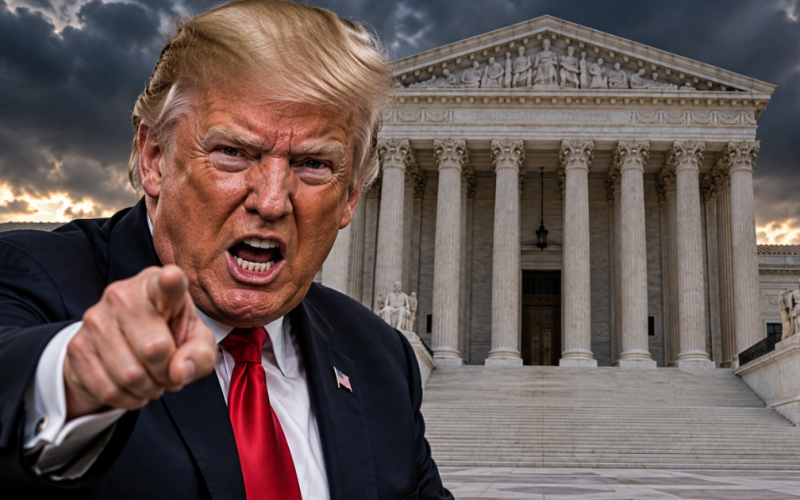
The Supreme Court has allowed a lower court order blocking a new U.S. Postal Service mail ballot rule from taking effect before the November midterm elections.
The justices declined the Trump administration’s request to overturn the lower court’s order, meaning the disputed rule will not be implemented for elections taking place on or before Nov. 3, 2026.
The decision was issued Monday night in a brief one-paragraph order.
Justice Brett Kavanaugh wrote separately to explain why he agreed with the majority.
Kavanaugh said his concern was primarily about timing rather than necessarily the underlying legality of the rule.
With Election Day only weeks away, Kavanaugh concluded that state and local officials did not have enough time to reasonably implement the changes.
“State and local election officials do not have sufficient time to reasonably implement the rule before the elections,” Kavanaugh wrote.
Justices Samuel Alito and Clarence Thomas dissented.
The dispute stemmed from a Postal Service rule connected to an earlier Trump administration executive order involving mail voting.
Several states challenged the changes in court.
A federal district court in Massachusetts eventually issued an order preventing the Postal Service from implementing the key portions of the rule for elections occurring before or on Nov. 3.
The Trump administration then asked the Supreme Court to intervene.
The justices declined.
As a result, states will continue administering mail voting during the 2026 midterms under the procedures already in place when the election cycle began.
States will manage their voter lists and mail ballot systems without the additional federal processes contained in the blocked Postal Service rule.
The court’s decision followed weeks of legal maneuvering.
Earlier litigation had focused on the executive order that led to the Postal Service rule rather than the final rule itself.
The Supreme Court previously rejected that challenge on procedural grounds.
Once the rule itself became the focus of litigation, the Massachusetts court stepped in and blocked its implementation for the upcoming election.
Kavanaugh’s concurrence emphasized that his vote should not necessarily be interpreted as a judgment on the rule’s ultimate legality.
Instead, he focused on the practical difficulty of changing election procedures shortly before voting.
A group of state and local election officials had made a similar argument in a filing with the Supreme Court.
That group included seven Republican chief election officials.
They asked the court to allow the 2026 general election to proceed using the mail voting rules already in place.
The officials argued that implementing the new Postal Service requirements so close to Election Day would create major logistical problems, per Declare.
They specifically said the court could reach that outcome without deciding whether the rule itself was lawful.
Kavanaugh’s reasoning largely followed that timing-based approach.
Alito and Thomas disagreed.
According to the source, the two justices relied in part on representations from 12 state attorneys general who had argued earlier that compliance with the rule was still possible.
Utah Lt. Gov. Deidre Henderson, one of the Republican election officials who had urged the court not to impose the new rule this year, welcomed the decision.
“As expected, the United States Supreme Court has upheld the injunction blocking the USPS mail ballot rule,” Henderson said.
She added that “Utahns can have confidence that the 2026 election will proceed as normal.”
Utah is notable because it is the only Republican-leaning state among eight states that conduct elections primarily or entirely by mail.
President Donald Trump sharply criticized the Supreme Court’s decision.
Trump called it a “horrible, highly political, ruling.”
He also took aim at several of his own Supreme Court appointees.
“These are not the people I interviewed to serve on the United States Supreme Court,” Trump wrote.
Justices Kavanaugh, Amy Coney Barrett and Neil Gorsuch, all nominated by Trump, were among the seven justices who allowed the lower court’s order to remain in place.
For the 2026 midterms, the immediate impact is straightforward.
The new Postal Service mail ballot rule will not take effect before Election Day.
States will instead continue using the mail voting systems and procedures they had already established.
