

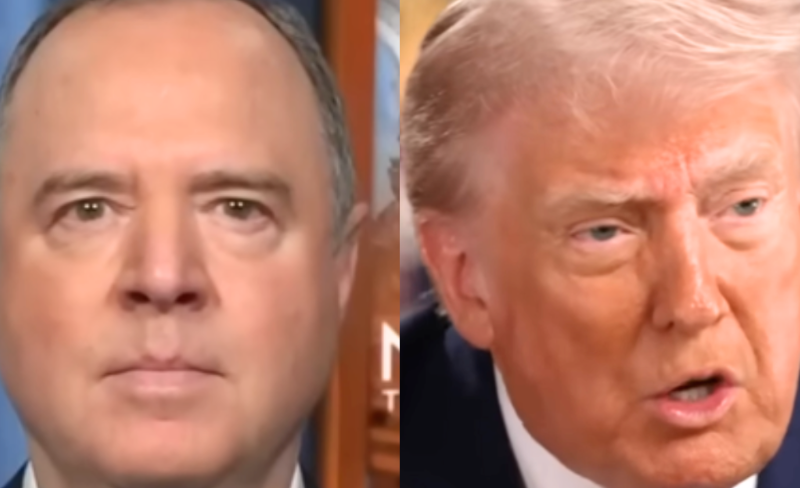
Washington rarely produces moments where fierce political rivals stand on the same side of an issue, but that is exactly what has happened as pressure mounts to save America’s film industry.
At the center of this unusual pairing are President Donald Trump and California Senator Adam Schiff, two men whose political history includes an impeachment battle and years of open hostility.
Schiff, who helped lead the charge against Trump during his first impeachment while serving in the House, has now thrown his support behind one of the president’s signature economic proposals.
The issue drawing them together is a federal production incentive, a policy Trump says would stop the steady exodus of entertainment jobs from American soil.
Writing on the social media platform X, Schiff declared his position in blunt terms.
“I am in strong agreement with the President,” he wrote.
He then called for immediate congressional action, stating, “Congress should immediately take up and pass a federal film tax incentive to bring back these good-paying jobs that we’ve lost to other countries.”
Schiff did not stop at a simple endorsement. He extended an olive branch across the aisle, writing, “Let’s work together — Republicans and Democrats — to get this done, and bring the movie magic back to America.”
The backdrop to this alliance is grim.
Bureau of Labor Statistics figures cited by Fox News show the motion picture and video industries have hemorrhaged approximately 49,000 jobs since 2022, a downturn tied to pandemic-era disruption and the industry’s shift toward streaming.
Trump’s public push for federal intervention followed a sit-down with actor Jon Voight, who holds the title of special ambassador to Hollywood within the administration.
Following that meeting, Trump made his case directly, posting online that “Congress should approve, immediately, a Federal Production Incentive to create Entertainment Jobs in America.”
He characterized the plan as something that “can be done quickly, accurately, efficiently and, importantly, will benefit ALL of America.”
Timing presents a major obstacle.
Congress returns for a compressed September session, with lawmakers already shifting focus toward the midterm elections, leaving a narrow window for new legislation to advance.
Trump has pressed for urgency anyway, pointing to production companies increasingly bypassing Hollywood altogether in favor of cheaper locations, both domestically and abroad.
California lawmakers have not ignored the warning signs. State officials more than doubled the Film & Television Tax Credit Program, pushing it to $750 million in available incentives.
Even that expanded figure leaves California trailing behind other states competing aggressively for the same productions.
Georgia now offers more than $1 billion in annual production tax incentives. New York trails Georgia but still provides close to $800 million, according to figures reported by Fox News.
The competition extends beyond U.S. borders as well, with Canada and the United Kingdom both luring American productions overseas through their own incentive programs.
Trump has been blunt about the consequences for California specifically, saying, “There is no incentive to be there, and it is hurting California very badly.”
The president credited Voight and other industry figures with pushing federal officials to consider incentives that could help American productions compete globally.
Trump summarized his ambitions for the initiative in characteristically forceful language, saying the goal is to “Make our Movie and Television Production Business GREAT AGAIN, perhaps GREATER THAN EVER BEFORE!”
Whether the legislation actually clears Congress remains an open question, particularly given the shortened legislative calendar ahead.
What is no longer in question is that Trump has picked up support from a Democrat who spent years opposing him at nearly every turn, a development Fox News described as unexpected.
Schiff’s willingness to publicly align with Trump on this issue marks a notable departure from the adversarial pattern that has defined their relationship for years.
For now, both men are pointing in the same direction, urging Congress to set aside partisanship and move on legislation neither side disputes is needed.
