

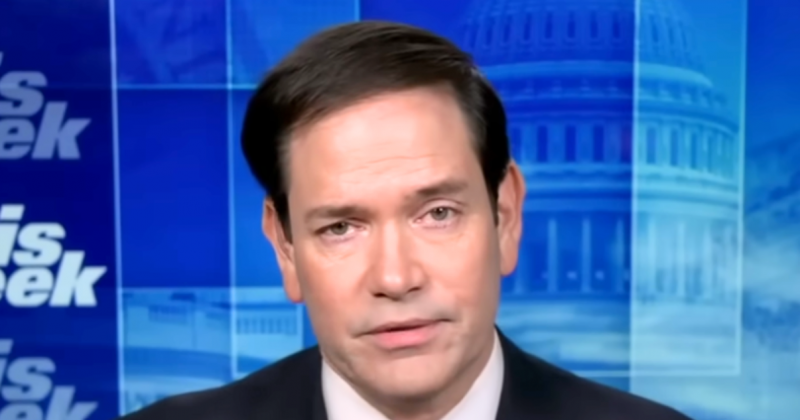
Secretary of State Marco Rubio delivered a pointed warning to Cuba’s communist leadership following the capture of Venezuelan dictator Nicolas Maduro during a pre-dawn U.S. military operation on Saturday.
The operation’s success has raised questions about potential American actions against other socialist regimes in the region.
Both Trump administration officials indicated that Cuba and Nicaragua could face consequences in the wake of Maduro’s detention.
During a Saturday afternoon press conference, President Donald Trump addressed Cuba’s deteriorating situation.
“Well, Cuba is an interesting case. Cuba, as you know, is not doing very well right now. That system has not been a very good one for Cuba,” Trump stated.
“The people there have suffered for many, many years. And I think Cuba is going to be something we’ll end up talking about because Cuba is a failing nation right now,” he added.
The president emphasized his concern for both Cubans living on the island and those who fled to America.
“Very badly failing nation. And we want to help the people of—it’s very similar in the sense that we want to help the people in Cuba, but we want to also help the people that were forced out of Cuba and living in this country,” Trump said before inviting Rubio to comment.
Rubio stepped to the podium and reminded journalists of his earlier statement.
“Well, I mean, I just gave you a statement a few minutes ago about, you know, when the president speaks, you should take him seriously,” the secretary declared.
The secretary of state then launched into a scathing assessment of Cuba’s current condition.
“So suffice it to say, you know, Cuba is a disaster. It’s run by incompetent, senile men and in some cases not senile but incompetent nonetheless. It has no economy. It’s in total collapse. And by the way, you know, they were—all the guards that helped protect Maduro, this is well known, their whole spy agency, all that were full of Cubans. I mean, they basically—it’s amazing—this poor island took over Venezuela in some cases,” Rubio explained.
He pointed to Cuba’s extensive presence in Venezuelan security operations.
“One of the biggest problems that Venezuelans have is they have to declare independence from Cuba. They tried to basically colonize it from a security standpoint. So, yeah, look, if I lived in Havana and I was in the government, I’d be concerned at least a little bit,” the secretary added.
The relationship between Havana and Caracas dates back to Hugo Chávez’s rise in 1999.
This partnership developed into a deeply connected alliance characterized by mutual dependence, with Venezuela providing economic assistance while Cuba supplies expertise in multiple sectors.
The alliance survived Chávez’s death in 2013 and continues under Miguel Díaz-Canel’s leadership in Cuba. Díaz-Canel assumed power after the Castro family controlled the island nation since the revolution in the 1950s.
Venezuela sends Cuba up to 100,000 barrels of oil daily at heavily subsidized rates.
These shipments represent approximately $10-12 billion in annual subsidies, providing crucial energy supplies to Havana during its ongoing energy sector crisis.
President Trump’s order to blockade Venezuelan oil shipments has intensified Cuba’s difficulties.
Some analysts now project the Cuban regime could potentially collapse as a result of these energy supply disruptions, per the Wall Street Journal.
Cuba reciprocates by deploying tens of thousands of professionals to Venezuela.
Doctors, teachers, and technicians support various social programs throughout the South American nation.
Cuban influence extends deeply into Venezuela’s security apparatus.
Advisors from Havana, including intelligence and military personnel, have trained Venezuelan forces in guerrilla warfare, asymmetrical conflict strategies and counterinsurgency tactics.
This involvement includes significant participation in Venezuela’s intelligence services, particularly SEBIN.
Cuban operatives assist in suppressing dissent and maintaining regime control throughout Venezuela.
During a Sunday appearance on “Meet The Press,” host Kristen Welker asked Rubio whether Cuba was “next” for U.S. action.
The secretary acknowledged Cuba represents a “huge problem,” prompting Welker to ask if that constituted a “yes.”
“I think they’re in a lot of trouble, yes. I’m not going to talk to you about what our future steps are going to be and our policies are going to be right now in this regard, but I don’t think it’s any mystery that we are not big fans of the Cuban regime,” Rubio responded.
He reiterated Cuban control over Venezuelan government operations.
“One of the untold stories here is how, in essence, you talk about colonization, because I think you said [Venezuelan Vice President] Delcy Rodriguez mentioned that. The ones who have sort of colonized, at least inside the regime, are Cubans. It was Cubans that guarded Maduro. He was not guarded by Venezuelan bodyguards. He had Cuban bodyguards,” Rubio stated.
“In terms of their internal intelligence, who spies on who inside to make sure there are no traitors, those are all Cubans,” the secretary concluded.
