

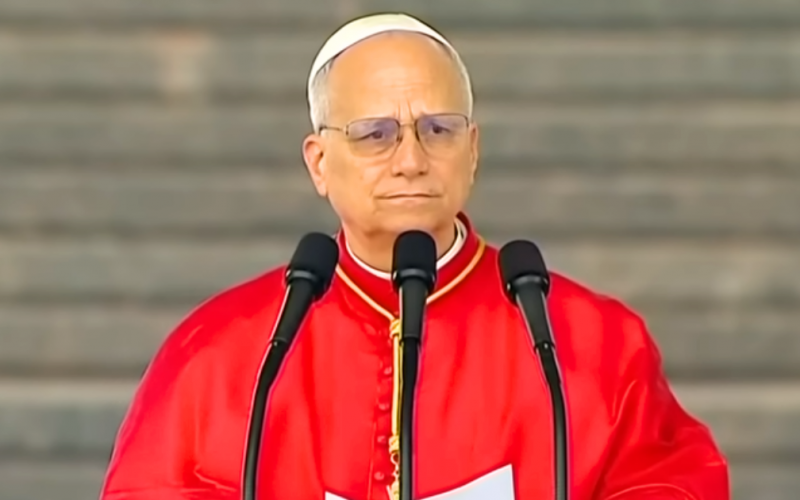
A visit by Pope Leo XIV to a mosque in Algeria during the opening leg of his Africa tour has triggered online backlash, with critics arguing the pontiff is overlooking violent attacks on Christian communities elsewhere on the continent, particularly in Nigeria.
The controversy erupted as the pope began an 11-day trip across Africa, with stops planned in Algeria, Cameroon, Angola, and Equatorial Guinea.
The Vatican has described the journey as a major diplomatic and spiritual outreach effort aimed at strengthening ties with Muslim communities and reinforcing the Catholic Church’s presence in a region where its membership continues to grow rapidly.
In Algiers, Pope Leo was received by President Abdelmadjid Tebboune before visiting several symbolic sites, including a national war memorial honoring Algeria’s independence struggle.
also made a stop at a mosque in the capital, a gesture framed by church officials as part of broader interfaith engagement efforts between Christians and Muslims, The Guardian reported.
While Vatican officials have emphasized themes of dialogue and coexistence, the mosque visit quickly became the focal point of criticism online.
Social media users and commentators questioned the decision, arguing that the pope’s itinerary did not sufficiently address ongoing violence affecting Christians in parts of sub-Saharan Africa.
A wave of posts on X claimed the visit highlighted a disconnect between Vatican priorities and the realities facing Christian communities in countries like Nigeria, where extremist violence has persisted for more than a decade.
Some users accused the Church of emphasizing symbolic diplomacy over direct engagement with conflict zones.
Conservative commentator Tommy Robinson criticized the mosque visit, writing that the pope had “taken his shoes off to wander around” and arguing that Christians “have no rights now” in Algeria, while also questioning why Pope Leo had not visited what he described as “suffering Nigerian Christians.”
Other users echoed similar concerns.
One X user wrote that there is “a whole Christian genocide going on in Nigeria,” arguing that the pope should prioritize what they described as persecution in Africa, adding that Christians were “being victims” in conflicts across the region and questioned the Vatican’s focus on Middle East-related diplomacy instead.
Another commenter, identifying as a Catholic, wrote that the pope’s actions “move funny,” arguing that attention should be directed toward Nigeria.
The post said Christians there were “being massacred during Easter” and criticized what it described as a lack of strong public condemnation from the Vatican.
Additional reactions were more sharply worded.
Texas congressional candidate Valentina Gomez wrote that Pope Leo “might as well become an imam,” criticizing the decision to visit a mosque rather than focusing on Christian communities in Nigeria.
Others offered a different perspective.
Commentator Mario Nawfal framed the mosque visit in political terms, linking it to broader geopolitical tensions and suggesting the gesture carried symbolic weight beyond religious diplomacy.
Despite the online backlash, Vatican officials have not directly responded to the criticism surrounding the Algeria visit.
Church representatives have instead highlighted the trip’s broader purpose, emphasizing interfaith dialogue, historical Christian ties in North Africa, and the Church’s growing engagement across the African continent.
Algeria holds particular symbolic significance for the Catholic Church as the birthplace of Saint Augustine, one of early Christianity’s most influential theologians.
The Augustinian tradition, which stresses unity and coexistence, has been cited by Vatican figures as an important theological backdrop for the visit.
Supporters of the trip argue that the pope’s focus on dialogue reflects a long-standing Vatican approach to engaging Muslim-majority nations.
Critics, however, maintain that the timing and optics of the mosque visit risk overshadowing urgent concerns about Christian persecution in other parts of Africa.
As the Africa tour continues, the debate highlights a broader tension facing the global Church: balancing diplomatic outreach and interfaith cooperation with rising demands for stronger responses to violence affecting Christian populations in conflict regions.
WATCH:
