

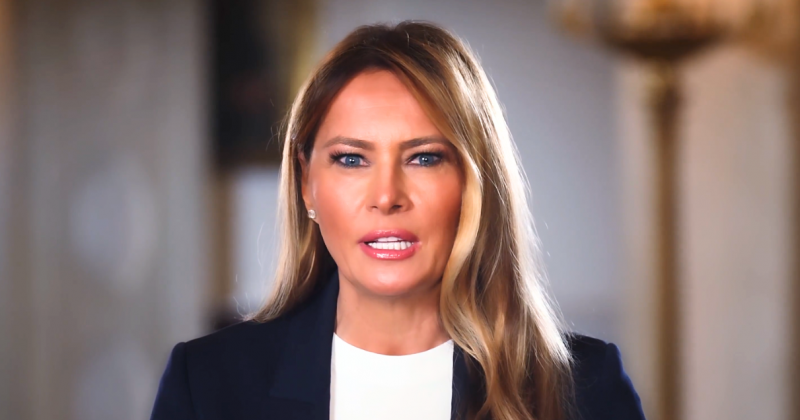
First lady Melania Trump took the chair of the United Nations Security Council on Monday, becoming the first sitting U.S. first lady—and the first first lady from any nation—ever to preside over the body.
The appearance came just days after the United States and Israel launched a sweeping joint military operation against Iran known as “Operation Epic Fury,” which claimed the life of Iranian Supreme Leader Ayatollah Ali Khamenei along with other senior Iranian leaders.
The United States formally assumed the rotating UN Security Council presidency on Monday, the same day Mrs. Trump took the podium to deliver her remarks.
The joint operation targeted Iranian military infrastructure and ballistic missile sites, with U.S. officials describing those sites as posing an “imminent threat.” Military planners indicated the operation is expected to continue for several days.
President Donald Trump, speaking over the weekend, issued a stark warning to Tehran against any retaliation, saying Iran would be met with “a force that has never been seen before” if they were to “hit very hard.”
Mrs. Trump’s address to the Security Council had been scheduled prior to the launch of Operation Epic Fury and focused on education, technology, and global peace.
“The U.S. stands with all of the children throughout the world,” she told the assembled delegates. “I hope soon — peace will be yours.”
The Security Council consists of 15 member states, including five permanent members—the United States, China, France, the Russian Federation, and the United Kingdom—as well as 10 nonpermanent members: Bahrain, Colombia, Democratic Republic of the Congo, Denmark, Greece, Latvia, Liberia, Pakistan, Panama, and Somalia.
Mrs. Trump addressed the full body directly, saying, “Collectively, your mission to maintain security while upholding the responsibility of preventing conflict during times of both war and peace is significant, must be applied evenly, and should never be carried out lightly.”
She added: “Peace does not need to be fragile.”
The first lady argued that education shapes the foundations of national character and serves as a bulwark against conflict. “A nation that makes learning sacred protects its books, its language, its science, and its mathematics — it protects its future,” she said.
She stated that children raised in societies that prioritize learning “develop confidence, innovate, build, compete, and maintain a deep value system,” and that their education “fosters empathy for others, transcending geography, religion, race, gender, and even local norms.”
Mrs. Trump called education a “fundamental human right,” noting that “so many children and young adults are banned from attending secondary schools and universities.”
She warned that societies restricting access to knowledge pay a price: “A society that excludes vast segments of its population can realize only a fraction of its potential.”
The first lady turned her attention to technology, declaring that “knowledge is power” and urging the global community to pursue universal digital access. “The global community must facilitate complete access to technology so that every individual can reach their full potential through education,” she said.
She cited current connectivity figures, noting that approximately 6 billion individuals—around 70 percent of the world’s population—currently own a mobile device and access the internet.
Mrs. Trump raised the concept of a future “single digital nation-state,” calling the idea potentially within reach given that “digital currency and payment systems via blockchain, plus AI’s massive factual database is already revolutionizing media and financial markets.”
She described artificial intelligence as “democratizing knowledge” and “redefining who gets to participate in the global economy of ideas,” and called on member nations to connect remote populations to AI-driven educational tools.
“Let’s connect everyone to knowledge through AI, including those in the most remote geographic regions of our world,” she said, adding that “AI can provide us with an understanding of each other’s needs.”
Mrs. Trump closed by urging Security Council members to “pledge to safeguard learning in our communities and promote access to heightened education for all,” and to “build a future generation of leaders who embrace peace through education.”
WATCH:
The address builds on the first lady’s long-standing advocacy for children’s online safety through her “Be Best” initiative, first launched during the initial Trump administration. In May 2025, President Trump signed into law the Take It Down Act, which criminalizes internet abuse involving nonconsensual explicit imagery—legislation Mrs. Trump had championed on Capitol Hill.
She also launched the Presidential Artificial Intelligence Challenge, a nationwide initiative inviting students and educators to participate by visiting AI.gov.
