

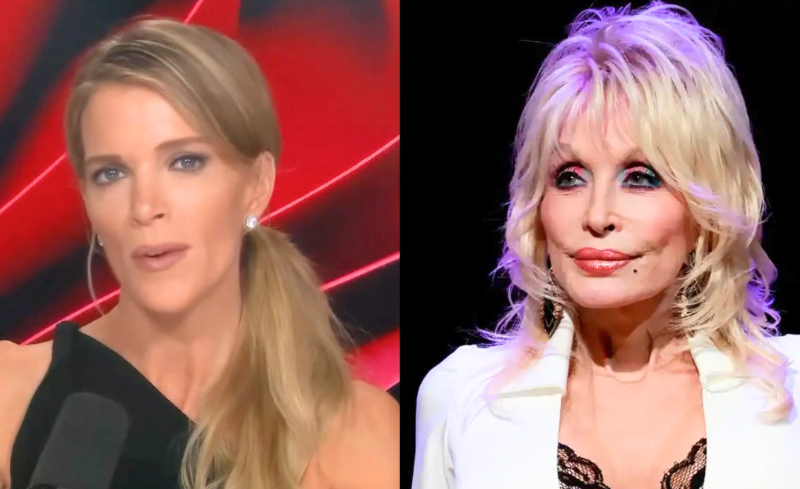
A wave of online fury engulfed Megyn Kelly on Tuesday after she posted a heartfelt tribute to country legend Dolly Parton, who died earlier that day at age 80 following a brief battle with cancer, according to her publicist.
Kelly’s message, shared on X, offered praise without any political framing.
She wrote, “Dolly Parton seemed as close to total goodness as any mere mortal could come.” She added, “She united us all in our love and admiration for her and, now, in mourning her. God bless you Dolly. R.I.P.”
Despite the tribute’s simple tone, thousands of users flooded the replies with criticism, arguing that Kelly’s conservative political identity stood in sharp contrast to Parton’s long record of supporting liberal causes.
The top-liked response accused Kelly of insincerity, reading, “Dolly was everything you aren’t: warm, generous, beloved – and good television.”
Another widely shared reply went further, claiming Parton “despised everything” that Kelly and conservatives broadly “represent.” The same user added that Parton “was actually the things you fake Christians pretend to be.”
Overnight, the backlash intensified.
Numerous commenters labeled Kelly a divisive figure, with many replies laced with profanity aimed directly at her.
One user framed Parton as a moral benchmark, writing, “Dolly was the example of what a Christian should be: unconditional love for all people.”
A separate comment took a harsher tone, stating, “She was loving, warm, non judgmental unlike you,” before adding, “F@#% off and keep Dolly’s good name out of your filthy, hateful mouth!”
Another critic listed specific examples of Parton’s political record to contrast with Kelly’s, writing, “Dolly Parton supported the LGBTQ community. Dolly endorsed COVID vaccinations. Trump stopped funding to Dolly’s Imagination Library. You sick f**ks are now all in on Dolly? Capitalizing politically on her death!”
That same user said they planned to vote for Democrats in the upcoming midterm elections.
Parton had spent decades championing progressive causes, including LGBTQ+ equality, transgender rights, racial justice and broader social inclusion.
Amid the online clash, President Donald Trump offered his own remembrance of Parton during a Tuesday call-in appearance on the Glenn Beck Program.
He called her death “a true loss for millions of people” and likened it to “losing a member of the family.”
Trump’s tribute carried added significance given Parton’s history with his administration. She twice declined the Presidential Medal of Freedom while he was in office.
The first refusal, she explained, came because her late husband, Carl Dean, was ill at the time.
Her second decision to decline the honor occurred during the COVID-19 pandemic, when Parton said she simply did not want to travel.
Parton was consistent in her approach to political honors — she also turned down the same award when it was offered by former President Joe Biden, citing a desire to avoid appearing politically aligned.
That philosophy was one Parton articulated publicly on multiple occasions.
In a 2017 interview with Fox News, she said, “Everybody knows I don’t do politics.” She continued, “My mother was a Democrat and my daddy was a Republican, so I’m a hypocrite.”
Parton revisited the topic in a 2019 podcast appearance, reflecting on how quickly a public backlash can end a career.
She cited the Dixie Chicks as an example, referencing the group’s sharp decline in popularity after members criticized then-President George W. Bush and the Iraq War in 2003.
“You can ruin a career for speaking out,” Parton said at the time, underscoring why she avoided political statements throughout her decades-long career.
Kelly, for her part, has developed a reputation for blunt and often polarizing commentary since her departure from mainstream broadcast television.
That departure followed 2018 remarks in which she defended wearing blackface as part of Halloween costumes.
The clash over Kelly’s tribute has renewed public attention on how Parton balanced her personal political beliefs with a career-long effort to remain a unifying, nonpartisan figure.
Commenters on both sides of the debate cited Parton’s past interviews and public statements to support their characterizations of her legacy.
As of Tuesday night, reactions to Kelly’s post continued to generate significant engagement online, with no signs of the debate slowing down.
