

The U.S. Supreme Court this week confronted a major constitutional dispute that could redefine the scope of birthright citizenship, as justices weighed the legality of President Donald Trump’s executive order limiting automatic citizenship for children born to illegal aliens and temporary visitors.
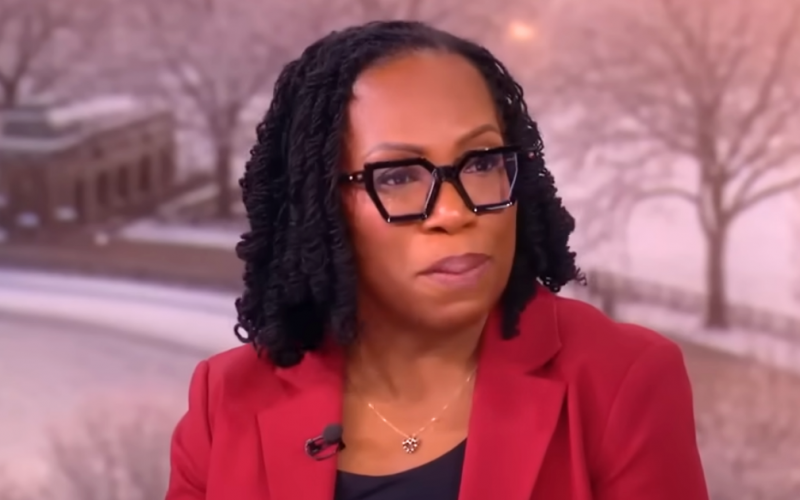
Early in the arguments, Justice Ketanji Brown Jackson drew attention for a hypothetical that underscored the broader disagreement over how the 14th Amendment should be interpreted.
Rather than focusing narrowly on immigration policy, Jackson explored whether physical presence alone can establish “allegiance” to a country.
“I was thinking, I, a U.S. citizen am visiting Japan. And what it means is that if I steal someone’s wallet in Japan, the Japanese authorities can arrest me and prosecute me,” Jackson said, suggesting that even temporary presence subjects individuals to a nation’s authority.
She then extended that reasoning to the United States, questioning whether similar obligations apply domestically.
“Is that the right way to think about it? And if so, doesn’t that explain why both temporary residents and undocumented people would have that kind of allegiance just by virtue of being in the United States?” Jackson asked.
At the center of the case, Trump v. Barbara, is a fundamental constitutional question: whether the 14th Amendment’s citizenship clause guarantees universal birthright citizenship or was originally intended to secure rights for freed slaves following the Civil War, according to The Daily Caller.
Representing the administration, Solicitor General D. John Sauer argued that historical evidence supports a narrower interpretation. He pointed to debates among the amendment’s framers, emphasizing that they rejected the idea that temporary or unlawful presence alone could establish the kind of allegiance required for citizenship.
“There’s a sort of allegiance from persons temporarily resident in the United States whom we have no right to make citizens,” Sauer said, citing statements from lawmakers involved in drafting the amendment.
According to PJ Media, his argument focused on the distinction between mere presence and permanent attachment, asserting that citizenship has traditionally been tied to domicile rather than short-term residence.
Other members of the court also pressed both sides during the arguments.
Chief Justice John Roberts questioned whether birthright citizenship policies have been exploited by foreign nationals, while Justice Amy Coney Barrett examined how the administration’s interpretation would apply in historical contexts, including to newly freed slaves.
The exchanges highlighted the difficulty of applying 19th-century constitutional language to modern immigration issues.
Outside the courtroom, opposition to the executive order remains strong.
The American Civil Liberties Union, represented by attorney Cecilia Wang, argued that the policy conflicts with longstanding precedent.
“The phrase ‘subject to the jurisdiction thereof’ has absolutely nothing to do with modern-day policy concerns about illegal immigration,” Wang said, according to Patriot Fetch.
The scale of the issue highlights the stakes.
Estimates from the Center for Immigration Studies indicate that between 225,000 and 250,000 children were born to illegal alien parents in 2023, along with tens of thousands more born to temporary visitors.
A decision in Trump v. Barbara could carry far-reaching consequences, potentially reshaping how citizenship is defined in the United States and influencing immigration policy for years to come.
As deliberations continue, the case stands as a pivotal test of constitutional interpretation with implications extending well beyond the courtroom.
WATCH:
