

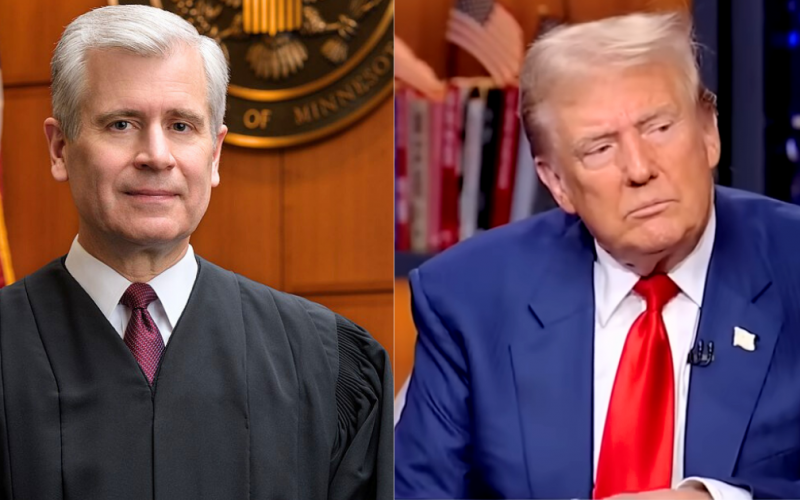
Minnesota’s federal courthouse has emerged as a focal point of friction between the judiciary and the Trump administration, as Chief U.S. District Judge Patrick J. Schiltz signaled the possible use of criminal contempt to enforce immigration rulings tied to the recent surge in federal enforcement.
On Thursday, Judge Schiltz issued a supplemental order sharply criticizing U.S. Immigration and Customs Enforcement (ICE) for repeatedly failing to comply with court directives requiring the release of certain illegal aliens or the scheduling of bond hearings
The order follows weeks of tension after the administration deployed thousands of agents to Minnesota as part of Operation Metro Surge, designed to address immigration violations rapidly.
According to Schiltz, an initial review identified 96 violations of release orders in 74 cases.
A second review challenged by Justice Department (DOJ) officials confirmed 97 violations in 66 cases, while a subsequent audit revealed 113 additional violations in 77 cases—many occurring after his initial warning to federal authorities, according to the Washington Times.
“This court will continue to do whatever is required to protect the rule of law, including, if necessary, moving to the use of criminal contempt,” Schiltz wrote. “One way or another, ICE will comply with this court’s orders.”
The escalation places the Minnesota bench on a collision course with the administration’s approach, which emphasizes swift detention and enforcement nationwide.
Minnesota has seen a surge in habeas corpus petitions from detainees challenging unlawful or prolonged confinement.
Federal judges have largely granted these petitions, ordering bond hearings or outright releases, reflecting concern over procedural compliance and detainee rights.
Schiltz specifically criticized U.S. Attorney Daniel N. Rosen for challenging the court’s findings rather than addressing systemic compliance failures.
Rosen argued that some figures were inaccurate and that his staff “didn’t deserve” public reprimand.
The judge countered that the DOJ had failed to prepare for the influx of litigation created by sending roughly 3,000 ICE agents into Minnesota, placing line attorneys in an “impossible position,” according to Bloomberg Law.
“What those attorneys ‘didn’t deserve’ was the Administration sending 3,000 ICE agents to Minnesota to detain people without making any provision for handling the hundreds of lawsuits that were sure to follow,” Schiltz wrote, according to KARE11.
Several attorneys have resigned, citing overwhelming caseloads approaching triple digits.
“Sometime(s) I wish you would just hold me in contempt, Your Honor, so that I can have a full 24 hours of sleep,” one lawyer reportedly told the court.
Other judges in the district are following Schiltz’s lead.
One ordered federal officials to reimburse travel costs after transferring a detainee contrary to a court order, while another scheduled a consolidated contempt hearing involving dozens of cases where ICE allegedly withheld detainees’ property.
Operation Metro Surge officially concluded under guidance from Trump administration border czar Tom Homan, but Schiltz warned that enforcement failures continue to have legal consequences.
“If anything is ‘beyond the pale,’ it is ICE’s continued violation of the orders of this Court,” he wrote.
With more than 200 identified violations, the court signaled it will take further measures if necessary to ensure compliance and protect judicial authority.
As Minnesota’s federal judges assert control, the case highlights the delicate balance between robust immigration enforcement and adherence to federal law.
Advocates argue that courts must hold agencies accountable, while the administration emphasizes the importance of swift action to maintain border security.
For Schiltz and his colleagues, the message is clear: the rule of law must be respected, and federal agencies are not above it.
