

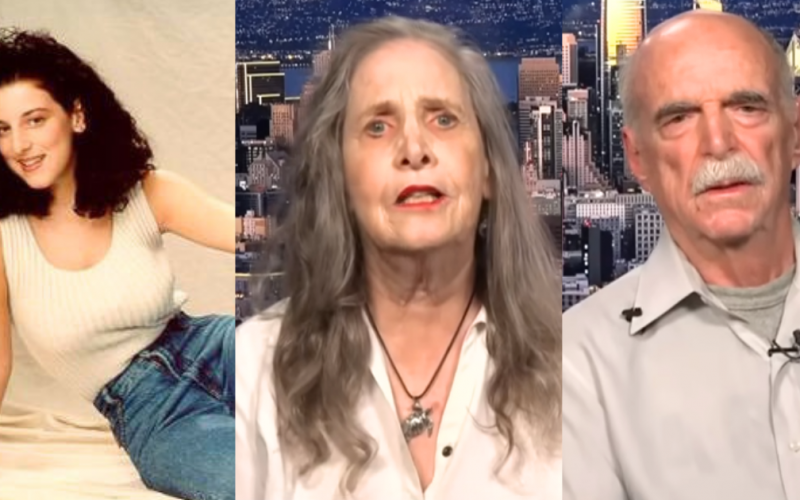
Nearly 25 years after the disappearance of Washington, D.C. intern Chandra Levy, her parents are speaking publicly again, revisiting long-standing unanswered questions in a case that remains one of the most closely examined unsolved investigations in the capital.
In a recent interview with NewsNation, Robert and Susan Levy revisited theories they say have followed them for decades, including the belief that their daughter’s curiosity about unidentified aerial phenomena may be an overlooked piece of the broader mystery surrounding her death.
They said they continue to wonder whether she may have come across information in Washington that went beyond ordinary circumstances.
“She says, ‘Oh, he believes in UFOs like I do’ and that he deals with this stuff,” Susan Levy said. “So then it left me thinking, knowing Chandra, she’s very inquisitive. Could she have known something that she wasn’t supposed to know? And could she have been wiped out because she knew too much?”
Levy was 24 years old when she disappeared on May 1, 2001, shortly before returning home to California after completing an internship with the Federal Bureau of Prisons.
Her disappearance quickly became national news and intensified after reports linked her socially to then-California Rep. Gary Condit, a development that drew heavy media attention at the time.
Although that connection dominated early coverage, investigators repeatedly stated that Condit was never considered a suspect in Levy’s disappearance and was never charged in the case.
For more than a year, the case remained without answers until May 2002, when hikers discovered human remains in Washington’s Rock Creek Park, not far from Levy’s apartment.
Authorities later confirmed the remains belonged to her and ruled the death a homicide, though critical details surrounding what happened remained unresolved.
People reported that a major shift came in 2009 when investigators arrested Ingmar Guandique, who was already incarcerated for unrelated assaults in the same park.
His 2010 conviction was initially viewed as a long-awaited breakthrough in a case that had gone cold for years.
However, that outcome later unraveled after questions emerged about the reliability of key testimony used at trial.
By 2016, federal prosecutors decided not to pursue a retrial, effectively dissolving the conviction and returning the case to unresolved status. Guandique was subsequently released and deported to El Salvador in 2017.
The reversal left Levy’s parents facing renewed uncertainty. Susan Levy described the moment as deeply painful, saying, “I feel shattered. It’s hard to accept that my daughter’s death is a cold case again.”
Robert Levy also noted that prosecutors continued reviewing issues tied to witness credibility even after the conviction collapsed, underscoring lingering questions about whether the full truth had ever been established.
Despite the passage of time, the Levys say they have never stopped searching for answers and believe critical information about the case may still not have surfaced.
Susan Levy told NewsNation she continues to call for transparency and insists the investigation is far from complete in her view.
“I’m stepping on a limb,” she said. “I’m asking for disclosure. Someone knows the truth of what happened to my daughter, Chandra, and what has happened to a lot of other people who have disappeared, gone missing, that have disappeared in some mysterious ways.”
WATCH:
