

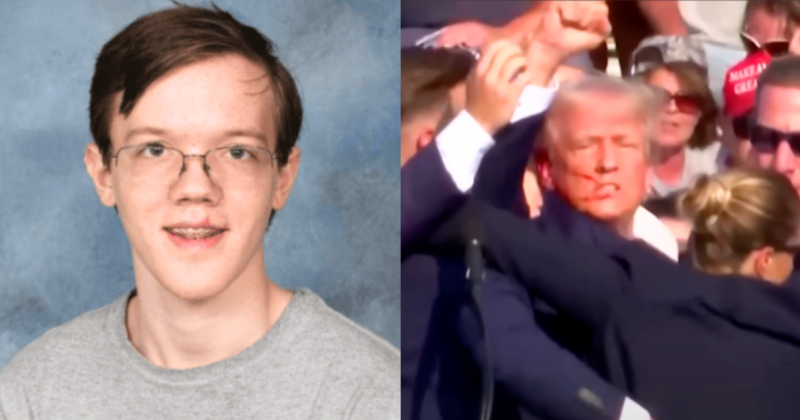
A quiet suburban household. A teenager who excelled in the classroom but vanished socially. And a fake name used to intercept packages before a father ever got home from work.
That’s the picture now emerging from newly disclosed federal records detailing the private world of the man who tried to kill President Donald Trump.
More than a year after Thomas Matthew Crooks opened fire at a campaign rally in Butler, Pennsylvania, federal documents are finally revealing just how isolated — and how secretive — his final years truly were.
The 20-year-old killed one rally attendee and wounded two others before law enforcement shot him dead on the scene in July 2024.
The trove of records, obtained by the New York Post and independently reviewed by Fox News Digital, was quietly delivered to the Senate months ago.
Sen. Chuck Grassley received the files back in March, and the documents were significant enough that President Trump himself was personally briefed on their contents.
Yet for all the new detail, one question remains stubbornly unanswered: why did he do it?
Perhaps the strangest revelation buried in the paperwork involves a false identity.
Investigators found that Crooks had been ordering packages under the name “Bob Dole,” carefully timing pickups so he could grab them from the doorstep before his father returned home from a long workday.
The alias wasn’t randomly chosen — it traces back to a cyberattack.
Matthew Crooks, the shooter’s father, told agents his own bank account had been hacked and hit with fraudulent gambling charges, and that breach appears to have pushed his son toward inventing a separate identity entirely.
Isolation defined much of Crooks’s adolescence, according to his father’s own account to investigators.
Despite going through the motions of typical teenage socializing, Crooks made a sharp distinction between acquaintances and actual friends.
His father put it bluntly to agents: his son “never identified anyone as a friend throughout middle school and high school.”
That interview took place just one day after the shooting, when FBI agents sat down with both of Crooks’s parents to begin piecing together his history.
What emerged was a young man who blended into his surroundings socially while remaining fundamentally disconnected from the people around him.
There were subtler warning signs, too.
In the months before the rally, Crooks’s father noticed him speaking aloud to himself, a detail he later shared with investigators.
Notably, the elder Crooks worked in the mental health field himself, yet he told agents he never observed additional behaviors that pointed toward a specific mental illness.
Academically, nothing about Crooks stood out as troubling.
His father described him as a straight-A student, the kind of kid who could sit down for the SAT without cracking a book and still walk away with a 1400.
Later, motivated to do better, he studied in earnest and pushed his score past 1500 on a retake.
But beneath the high marks sat real anxiety.
According to his father, Crooks was gripped by fear that his grades and scores still wouldn’t be enough to get him into college.
That worry lined up almost exactly with a broader shift in his personality that began between his freshman and sophomore years of high school.
Where he had once been more outgoing, Crooks grew withdrawn during that stretch.
Conversations with teachers became noticeably more difficult for him, a change stark enough that his father flagged it directly to federal investigators.
Amid that withdrawal, Crooks briefly entertained an entirely different future: a career in the military, specifically working aboard nuclear submarines.
Investigators who reviewed the claim, however, said it was never clear how serious he actually was about following through.
The aftermath of the shooting brought its own strange coda.
A family attorney told investigators that Crooks’s body was cremated shortly after his death — and that the cost was covered not by his family, but by an anonymous donor whose identity has never been disclosed.
His parents’ lives were upended almost immediately.
Matthew Crooks took early retirement in the wake of the attack, stepping away from his career altogether.
His mother, Mary Crooks, took a leave of absence from her job as the family tried to process what their son had done.
The documents form part of the sprawling federal investigation into the Butler rally shooting, an attack that has remained under intense scrutiny from Congress and security officials since the moment it occurred.
Taken together, the records paint the portrait of a socially isolated, academically gifted young man leading a hidden double life under a stolen identity — yet even with all these details now public, investigators admit they are no closer to understanding what actually drove him to pull the trigger.
