

Rushing whitewater does not negotiate.
When it claims a person, it holds them on its own terms — and in the summer heat of the Blue Ridge Mountains, it held David Lemley fast beneath the surface of a Georgia river with no intention of letting go.
What happened next placed a 13-year-old boy from Houston, Texas, into the record books of an organization more than a century old.
Devon Champenoy was among a group of scouts navigating Class 3 rapids during a summer camp outing when their troop leader took his first spill off the stern of the raft.
The water was moving fast, but Lemley climbed back in laughing, his helmet camera catching him grinning and calling out over the roar of the current.
Hot day. Fun ride. No harm done.
The second fall told a different story.
Lemley went over the side again — only this time, his foot jammed beneath the seat of the raft.
His torso and head were submerged. He could not move. The raft did not stop.
The river churned forward, and Lemley’s head caromed off submerged rocks with only his helmet standing between him and something far worse. His only chance to breathe came in the brief moments when the water level happened to drop far enough for his face to break the surface.
He had no way to free himself. He had no way to call for help. He had, at best, whatever seconds remained before the river made the decision for him.
“I have no doubt that if Devon hadn’t released my foot I was going to die,” Lemley later told KHOU 11 in Houston.
Champenoy did not freeze. He took a breath, found his footing on the lurching raft, and crossed the vessel to reach his leader. He freed the trapped foot. Kayakers on the water moved in to complete what the boy had started.
The rescue itself was only half the ordeal. Lemley’s foot had been broken in the incident, leaving him unable to function as pilot. Twenty minutes of whitewater still lay ahead. Champenoy stepped in, kept the remaining scouts composed, and brought the raft through to calm water.
“It took a while for me to take in the fact that this happened and I saved a life,” Champenoy said in the KHOU 11 interview, adding that he had not stopped to think — he simply moved.
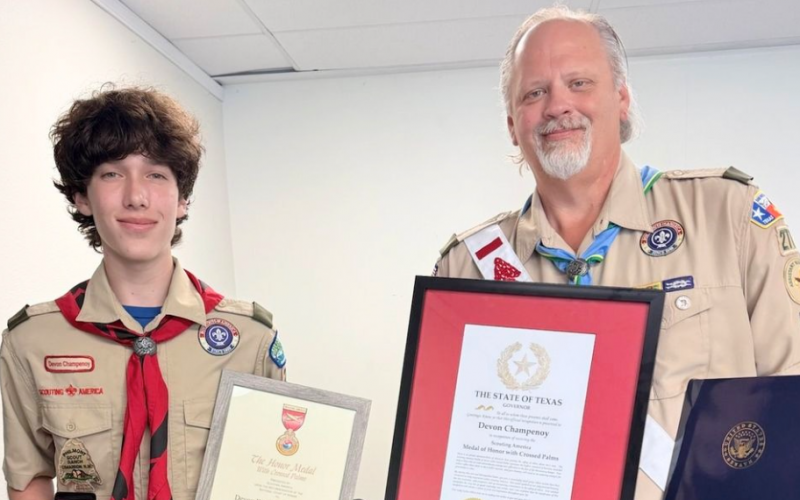
Lemley put his scout’s name forward for formal recognition. What Champenoy received in return was one of the rarest commendations in American scouting: the Honor Medal with Crossed Palms, awarded by the Boy Scouts of America for what the organization defines as unusual heroism demonstrated in saving a human life.
In more than a century of Boy Scout history, the medal has been awarded fewer than 300 times.
WATCH:
Texas Governor Greg Abbott separately recognized Champenoy with a commendation from the state.
Champenoy is now 15 and working toward Eagle Scout — the highest rank the Boy Scouts of America confers.
The river moves on. So does he.
