

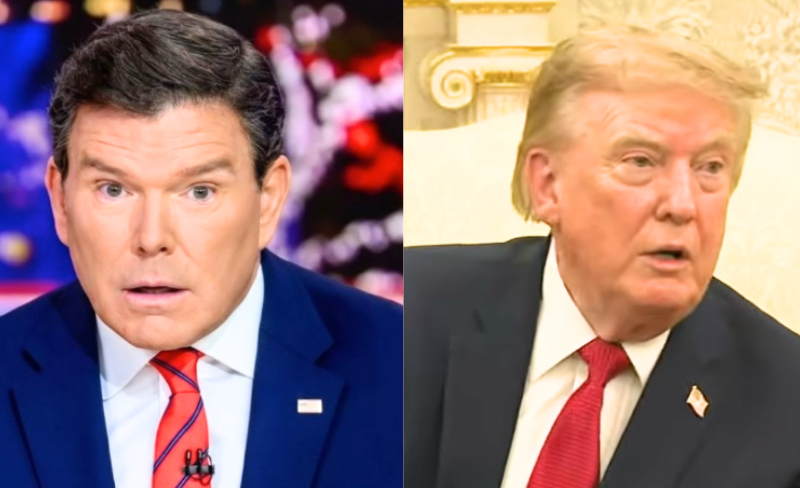
A leadership vacancy is opening at the top of the U.S. Army, and the man stepping away has deep personal ties to the vice president.
Dan Driscoll, the Army’s civilian secretary, has handed in his resignation, setting off a wave of reaction across Washington’s national security circles.
Word of the move broke publicly on Monday, when Fox News anchor Bret Baier shared the news live during his broadcast.
Baier’s on-air reaction suggested the timing had genuinely caught him off guard, despite his deep sourcing inside the capital.
Behind the scenes, the resignation had been building for months.
The Wall Street Journal, which broke the story, reported that Driscoll clashed repeatedly with War Secretary Pete Hegseth, with those tensions ultimately pushing Driscoll toward the exit.
At the heart of the dispute was personnel, not policy.
Driscoll pushed back against Hegseth’s decision to strip several senior Army generals of their commands, a move that reportedly deepened the rift between the two men.
The fallout from that dispute now leaves a leadership gap at the Army’s highest levels.
The Journal reported plainly on the scale of the vacancy: “With Driscoll’s departure, the Army will lack top Senate-confirmed civilian or military leaders.”
Filling part of that void is Gen. Christopher LaNeve, who has been serving in an acting capacity as the Army’s top uniformed officer.
He assumed that role only after Hegseth removed Gen. Randy George, the previous chief, from command.
On the civilian side, authority will shift to Mike Obadal. Once Driscoll formally departs, the Journal reported, Obadal — currently the Army undersecretary — will become the department’s ranking civilian official.
Driscoll’s Washington connections run deeper than his cabinet-level post.
He and Vice President JD Vance were classmates at Yale Law School, and the two have reportedly remained close in the years since, a relationship that has fueled speculation about Driscoll’s political future.
That speculation played out in real time during Monday’s Fox News broadcast, when Baier turned to Chief National Security Correspondent Jennifer Griffin to unpack the resignation. Baier opened with the headline itself: “And Jen, we’re just getting word now that the U.S. Army Secretary Dan Driscoll has tendered his resignation.”
Griffin’s response made clear the news, while significant, wasn’t shocking to those tracking internal Pentagon dynamics. “Well, it’s not surprising,” she said.
She went on to lay out exactly why.
“He’s a close ally of Vice President Vance, has been butting heads with Secretary Hegseth for months now,” Griffin said, before detailing the personnel dispute driving the split.
“In fact, he had disagreed with Secretary Hegseth’s decision to fire many of the Army’s top generals, top leaders, leading to a bit of a brain drain in the Army,” Griffin explained, confirming that Driscoll’s resignation had now been formally filed.
For Baier, the surprise centered less on whether Driscoll would eventually leave, and more on when.
“Thought he was gonna stay until after the midterms and run, maybe, Vice President Vance’s [2028 presidential] campaign,” he said, tying Driscoll’s now-uncertain future to speculation about Vance’s own political ambitions.
Driscoll isn’t the only War Department official heading for the exits this month.
Just days earlier, Ron Moeller, a close Hegseth aide serving as deputy assistant secretary of defense for strategic readiness, announced on X that he too was stepping down after roughly a year in the role.
Moeller framed his departure as long-planned rather than reactive, noting he had been sworn in the previous August and had always intended a one-year stint.
He also took pains to signal there was no rift with Hegseth or the administration.
“Today I submitted my formal resignation as the Deputy Assistant Secretary for Strategic Readiness,” Moeller wrote, before explaining the personal cost behind his decision.
“When I took on this task for @POTUS, @SecWar, & @USW_PR_HONTata, I promised a year; another year away from my wife whom I miss dearly. The resignation takes effect in 2 weeks,” he wrote.
He described a quiet return to civilian life ahead.
“I intend to go back to the Black Hills, recharge, chop lots of firewood for the winter, and ignore any and all journalists trying to get me to talk about my time in this historic and consequential administration,” Moeller wrote.
In a follow-up post, Moeller directly rejected any comparison to a past resignation rooted in policy opposition.
“For those of you expecting some sort of Joe Kent career suicide, I’m afraid you’ll be sadly disappointed,” he wrote — a reference to the former National Counterterrorism Center director who resigned over opposition to the Iran war.
Moeller closed out a Pentagon tenure built on decades of prior military, intelligence, and national security experience.
