

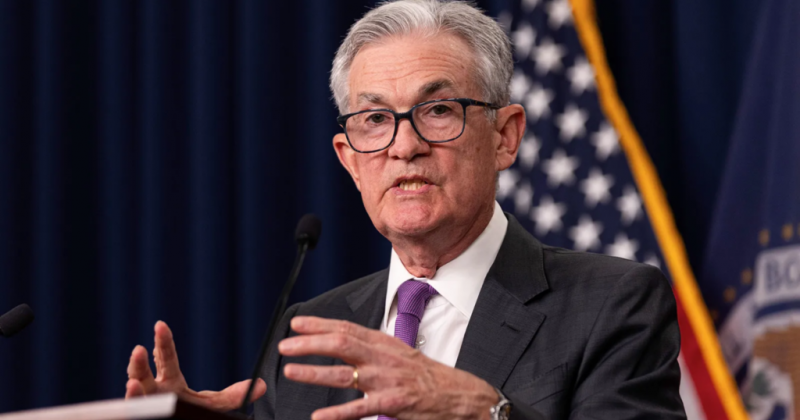
The United States Federal Reserve cuts interest rates by a quarter of a percentage point, delivering what is expected to be the final rate cut of the year.
The central bank announced on Wednesday that its benchmark rate would fall by 25 basis points to a range of 3.50 to 3.75 percent, a response to signs that job growth has slowed across the country.
In its statement, the Fed acknowledged that employment gains have weakened and that the unemployment rate has inched upward through September.
The bank noted that newer data reinforces this trend, while inflation has risen slightly and remains elevated. The cut had been widely anticipated, with CME FedWatch projecting an 89 percent chance of a reduction ahead of the announcement.
Fed Chair Jerome Powell: “Today the Federal Open Market Committee decided to lower our policy interest rate by a quarter percentage point.” pic.twitter.com/lCHuGNHaar
— Resist Times (@ResistTimes_US) December 10, 2025
This decision comes at a time when the Federal Reserve is dealing with significant gaps in economic data, a result of the record-breaking 43-day government shutdown.
During that period, federal agencies like the Department of Labor could not collect key information necessary for their regular reports. This affected data on producer prices, import and export prices, and state-level employment figures. The Bureau of Labor Statistics even confirmed it could not release October labor numbers due to insufficient resources.
Given these limitations, the most recent full set of data available to the Fed came from September, when unemployment ticked up to 4.4 percent and core inflation climbed to 2.8 percent.
A newer report released on Wednesday showed labor costs increasing 0.8 percent in the third quarter, slightly below expectations. These trends suggest the labor market is cooling, which may influence the Fed to take a more cautious approach to cutting rates next year.
Ryan Sweet of Oxford Economics noted that uncertainty remains high, but some of the pressures on the labor market could ease early next year. His analysis warned of the possibility of a “jobless expansion,” a scenario where GDP grows while employment barely improves, leaving the economy exposed to external shocks.
Political pressure continues to surround the Federal Reserve, despite its insistence on independence. President Donald Trump has repeatedly pushed for deeper rate cuts and criticized Fed leadership for moving too slowly.
The first cut of his second term came only in September, and he has made it clear he favors more aggressive monetary easing to stimulate economic activity.
The White House has placed economic adviser Stephen Miran on the Fed board, where he has consistently dissented in favor of half-point cuts instead of the more modest quarter-point reductions supported by most of the board. In the latest vote, Miran again pushed for a larger cut, while two governors—Austan Goolsbee and Jeffrey Schmid—opposed any cut at all. The rest of the board supported the 25 basis-point move.
Some analysts argue that Trump’s push for lower rates complicates the Fed’s efforts to balance inflation with borrowing costs. Daniel Hornung of Stanford’s Institute of Economic Policy Research noted that elevated inflation and missing data already make planning difficult, and political pressure only adds another layer.
Fed Chair Jerome Powell’s term ends in May 2026. In a recent Politico interview, President Trump said he would only appoint a successor who supports immediate rate cuts, underscoring how central monetary policy will remain in broader political debates.
