

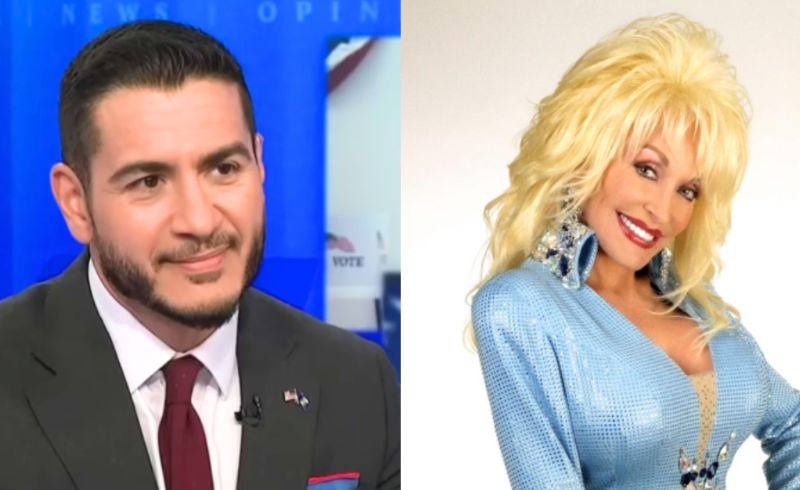
A message meant to honor a country music icon instead ignited a political brushfire this week, engulfing Michigan Senate candidate Abdul El-Sayed in fresh controversy just months before voters head to the polls.
The trouble began Tuesday, when news broke that Dolly Parton had died at age 80.
Her representatives said the beloved entertainer passed peacefully in Nashville following what they called a “brief battle with cancer.”
Within hours, an outpouring of grief swept across social media, uniting Americans across the ideological spectrum in mourning.
Into that moment stepped El-Sayed, the Democratic nominee vying for Michigan’s open Senate seat, with a post that many read very differently than he likely intended.
“Dolly Parton used her gift for music to highlight the challenges of poverty, inequality, and struggle in ways that uplifted and inspired working people,” El-Sayed wrote on X.
He paired the statement with lyrics from “Coat of Many Colors,” Parton’s autobiographical ballad chronicling her impoverished upbringing in rural Tennessee.
Rather than landing as a heartfelt farewell, the post detonated online.
Quote-posts and critical replies vastly outnumbered any expressions of agreement, as a chorus of conservative voices accused the candidate of hijacking a moment of national mourning for ideological gain.
Twitchy Managing Editor Sam Janney fired one of the earliest shots. “Leave it to you to exploit her death for political gain,” Janney wrote, tacking on an insult for good measure.
Chuck Ross, a reporter for the Washington Free Beacon, expressed disbelief at the timing of El-Sayed’s message. “I didn’t think anyone would actually politicize Dolly Parton’s death, but here we are,” Ross wrote.
Storm Paglia of Townhall Media offered a two-word dismissal before escalating further. “Quiet,” she wrote, then added, “You hate America.”
Chloe Smith, rapid response director for the Senate Leadership Fund, weighed in with a meme aimed squarely at the candidate, warning him to “Stay away from her.”
Skepticism toward El-Sayed’s framing extended beyond official campaign operatives and media figures. Ordinary social media users piled on as well.
“Gimme a break, Abdul is no fan of Dolly and I doubt she of him,” one wrote. “Dolly is a hard working kind person, NOT a socialist.” Another user needed only four words to render a verdict, branding El-Sayed a “Pandering pathetic buffoon.”
Few critiques cut deeper than the one from conservative commentator Debbie Schlussel, who questioned whether El-Sayed had any genuine connection to the struggles Parton sang about.
“Hilarious watching this privileged spoiled rich kid from wealthy Bloomfield Hills… pretend he’s down with the struggle of America’s working poor because he googles a Dolly Parton song. Total fraud. How many believe this phony knew the lyrics to any Dolly song?” she wrote.
What made the moment especially combustible, critics argued, was Parton’s own long-standing refusal to be claimed by either political party.
She addressed the subject directly in a 2020 interview. “I am not political, and I refuse to get caught up in political things,” Parton said at the time.
She went further, explaining that her broad appeal across the political divide was something she guarded deliberately.
“I don’t like to get involved in politics, because first of all, I have as many Republican fans as I do Democrats,” Parton said. “I don’t want to offend anybody, I have a right to myself.”
This is not the first time El-Sayed’s public statements have drawn conservative fire.
His past remarks on Sharia law, among other positions, have already become a target for Republicans working to frame him as too far left for Michigan’s electorate.
Meanwhile, tributes to Parton continued pouring in from across the country, celebrating not just her musical legacy but decades of philanthropic work that touched causes far beyond entertainment.
For El-Sayed, a gesture apparently intended to pay respect instead became fresh ammunition for opponents.
In a Senate race already shaping up as a referendum on his political identity, Republicans seized on the moment as proof of the very ideology they hope to spotlight ahead of November.
Neither El-Sayed’s campaign nor representatives for Parton’s family offered further comment on the criticism as of Tuesday evening.
The episode now joins a growing list of flashpoints defining a Senate contest that shows no signs of cooling down before Election Day.
