

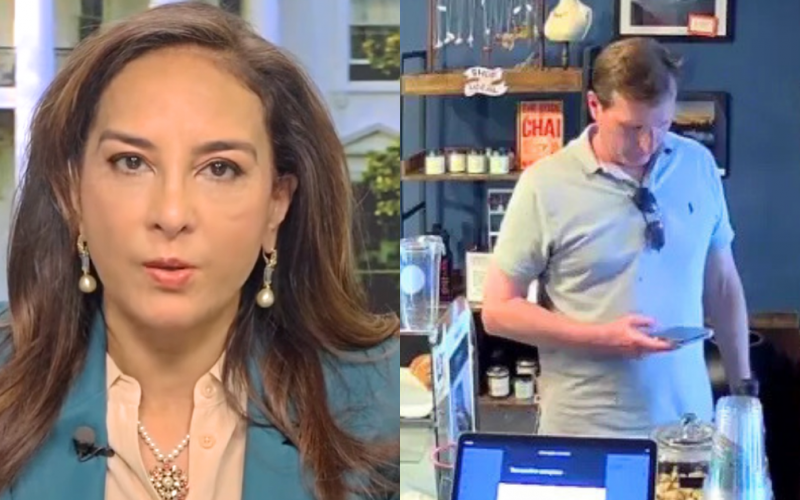
A Brooklyn coffee shop has become the center of a national political dispute after refusing future service to Rep. Dan Goldman, a Democratic congressman from New York, over his pro-Israel views, an episode that later prompted scrutiny from federal civil rights officials examining whether the business may have crossed into unlawful discrimination under public accommodations law.
Goldman, who represents New York’s 10th congressional district, said he briefly stopped at the café with his young daughter and later characterized the experience as “sad,” describing an otherwise routine interaction with staff that, at the time, gave no indication of the controversy that would soon follow.
Attention shifted after a now-deleted post attributed to the café surfaced online shortly after his visit.
The message criticized Goldman’s political positions on Israel and stated the business would not serve individuals associated with those views.
As the post spread across social media, it became the subject of competing interpretations online, with some framing it as political protest tied to the Israel–Gaza conflict and others raising questions about whether a public-facing business can exclude customers based on ideology rather than conduct.
The rapid circulation of screenshots pushed the story far beyond New York and intensified scrutiny of the café’s actions.
Within days, the Department of Justice’s (DOJ) Civil Rights Division opened a review after Assistant Attorney General Harmeet Dhillon indicated officials were assessing whether the café’s actions could fall under federal public accommodations law.
“Discriminating against people based on religion, race, or national origin is illegal,” she wrote on X. “Coffee shops are not exempt.”
The inquiry is examining how those protections apply when exclusions appear tied to ideology and political expression rather than clearly defined protected characteristics.
Officials have not described the matter as a violation and have avoided signaling any outcome, with the review still in its early stages and no enforcement decisions announced.
Legal questions remain focused on where courts draw the line between protected expression by private businesses and discriminatory denial of service in spaces open to the public.
Goldman, reflecting on the attention surrounding the incident, pointed to his brief interaction inside the café, noting that a staff member allowed his daughter to use the restroom and treated them courteously.
He said he responded in kind by purchasing coffee and leaving a tip, an exchange he described as unremarkable before the online reaction reframed it entirely, according to FOX 5 NY.
In the aftermath, Goldman told NBC News that he did not find it necessary for the DOJ to investigate the incident.
“I would rather they spend their time and resources investigating antisemitism against people who do not have a platform that I do, who are not elected officials, who do not, in some ways, ask for this,” he told the outlet. “I mean, I don’t ask for the antisemitism, but I’m a public figure, and I can accept the criticism.”
The café’s stated ethos of hospitality and openness has since been repeatedly referenced in coverage, often in contrast to the disputed post that sparked the controversy.
More broadly, the episode has underscored how quickly political disputes can spill into consumer spaces and evolve into questions of civil rights law when speech, identity, and public commerce intersect.
