

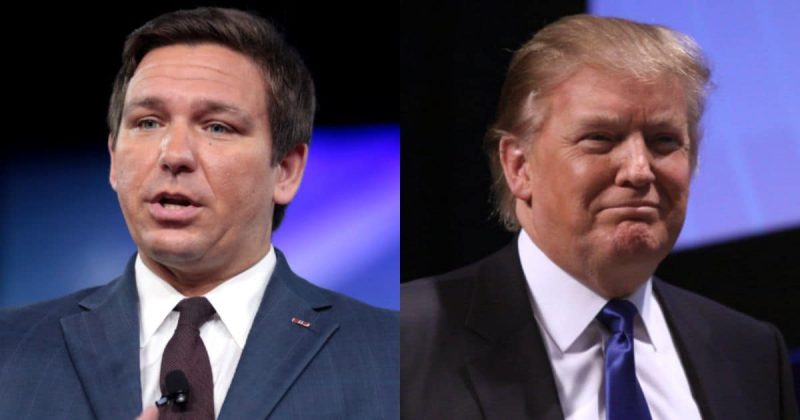
A clash between the White House and Florida’s governor has erupted over who controls artificial intelligence regulations in America.
President Donald Trump took to Truth Social on Monday to announce his opposition to state-level AI oversight, directly challenging Governor Ron DeSantis’ newly proposed Florida legislation.
The president made clear his position that the nation needs unified federal control over AI development and deployment.
Trump stated on his social media platform, “There must be only One Rulebook if we are going to continue to lead in AI.”
“We are beating ALL COUNTRIES at this point in the race, but that won’t last long if we are going to have 50 States, many of them bad actors, involved in RULES and the APPROVAL PROCESS,” he continued.
The president continued his argument by pointing to practical concerns for businesses operating across state lines.
“You can’t expect a company to get 50 approvals every time they want to do something. That will never work!” Trump wrote.
DeSantis unveiled his AI initiative on Friday through an official news release from the governor’s office.
The Florida governor has branded his legislative package as an “Artificial Intelligence Bill of Rights” designed to protect state residents.
According to DeSantis’ Friday announcement, the proposal aims to “establish an Artificial Intelligence Bill of Rights to define and safeguard Floridians’ rights – including data privacy, parental controls, consumer protections, and restrictions on AI use of an individual’s name, image or likeness without consent.”
The governor expanded on his vision in a social media post last week, emphasizing the protection of multiple state interests.
DeSantis wrote that the legislation “will also ensure protection for ratepayers, taxpayers, local governments, water resources, and Florida’s natural landscapes against so-called hyperscale data centers.”
The Florida governor concluded his statement by declaring, “We must put Floridians first!”
The White House appears prepared to take aggressive action against states that move forward with their own AI regulations.
A draft executive order from November outlined potential federal enforcement mechanisms, according to reporting from the New York Times,
The draft document indicates the US Attorney General would have authority to file lawsuits against states seeking to overturn their AI laws.
While the president has not yet signed a final order on this matter, the draft signals the administration’s serious intent to prevent state-level AI rulemaking.
