

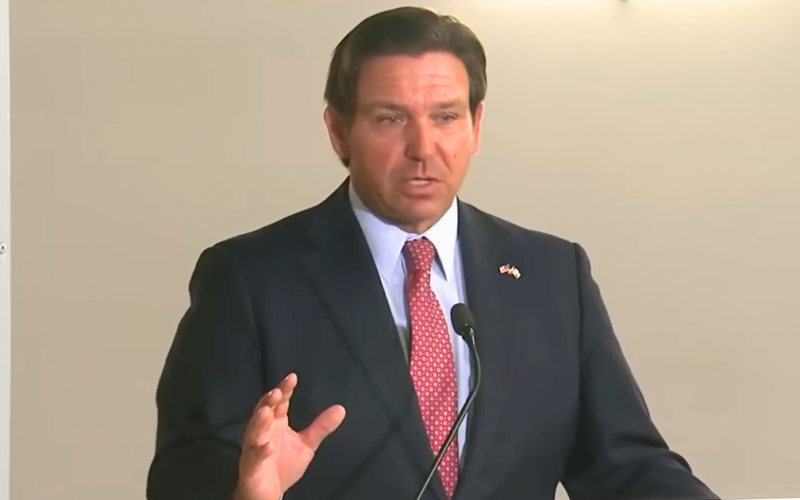
Florida Gov. Ron DeSantis (R) warned this week that local officials who refuse to cooperate with federal immigration authorities risk being removed from office, stressing that state law allows no tolerance for obstruction of enforcement.
On Fox News’ “The Ingraham Angle,” DeSantis contrasted Florida’s strict enforcement approach with jurisdictions nationwide that limit cooperation with Immigration and Customs Enforcement (ICE) or the Department of Homeland Security (DHS).
“If you act like Jacob Frey in Florida, then you get removed from your position,” he said, referencing the Minneapolis mayor who has publicly opposed certain federal immigration operations.
The governor framed the potential removal as a legal outcome rather than a political threat, emphasizing that Florida statutes require local law enforcement to assist federal authorities.
Officials who fail to meet these obligations, he said, are neglecting their statutory duties.
DeSantis linked enforcement compliance to public safety, arguing that communities where cooperation is restricted risk harboring individuals who should be detained or removed.
“Florida’s enforcement model is designed to prevent those situations,” he said.
The comments follow the state’s ongoing expansion of immigration initiatives.
Earlier this month, the governor highlighted “Operation Tidal Wave,” a coordinated effort involving state, local, and federal authorities.
According to the governor’s office, the initiative resulted in more than 10,000 arrests of illegal aliens, many with prior criminal convictions.
Across the country, ICE conducts targeted operations to detain individuals in the U.S. without authorization who pose threats to public safety, including fugitive operations and arrests connected to criminal activity.
Officials say these efforts are essential to maintaining federal enforcement priorities.
Sanctuary policies, which limit local cooperation with federal authorities, have long fueled national debate.
Supporters argue they foster trust between immigrant communities and local law enforcement, potentially improving public safety.
Critics contend that such restrictions hinder the removal of individuals who commit serious offenses.
Florida reinforced its legal framework in 2025 with legislation requiring local governments to enter agreements with federal authorities under 287(g) programs, allowing trained officers to assist in immigration enforcement.
The law outlines penalties for noncompliance, including civil, criminal, and removal measures.
Supporters of mandatory participation argue statewide consistency is crucial to uphold the rule of law and protect communities from crime linked to illegal immigration.
Republican lawmakers, including DeSantis, maintain that uniform enforcement prevents local governments from undermining federal or state initiatives.
Opponents, including immigrant advocacy groups and Democratic officials, warn the policy could weaken public trust, discouraging cooperation with law enforcement and undermining safety.
They argue that forcing local authorities into federal partnerships risks eroding community relationships.
In Orange County in 2025, local commissioners approved a federal cooperation agreement only after state officials warned that failure to comply could trigger removal or other penalties.
The agreement was described as necessary to align the county with statewide law.
The dispute illustrates the tension between state authority and local discretion. DeSantis has made clear that resistance will not be tolerated, signaling that enforcement provisions will remain a priority throughout 2026.
WATCH:
