

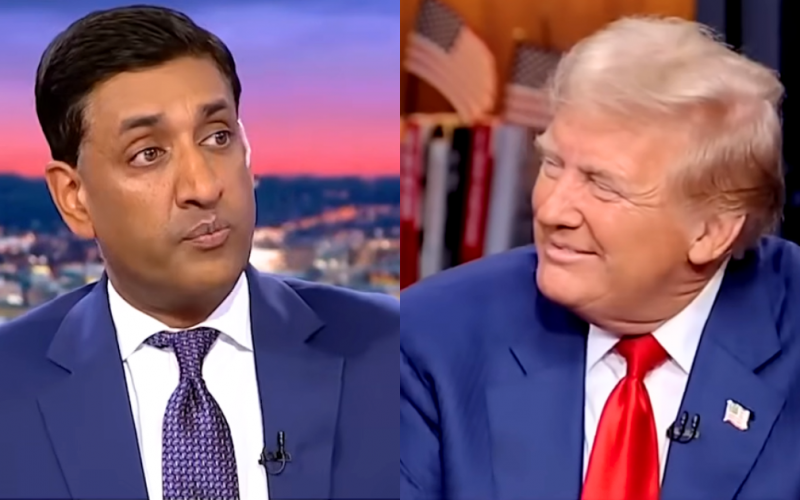
Rep. Ro Khanna (D-CA) drew sharp criticism Monday night after announcing his guest for President Trump’s upcoming State of the Union address: Haley Robson, a California woman who has publicly described herself as a former teenage “recruiter” for Jeffrey Epstein.
Robson shared her experiences in the Netflix docuseries Jeffrey Epstein: Filthy Rich, recounting her involvement in Epstein’s network that exploited underage girls.
Robson said she first encountered Epstein at age 16 in West Palm Beach, Florida, when a classmate suggested she could earn $200 by visiting his mansion and giving him a massage.
She stated that Epstein attempted to touch her during that visit but did not assault her. Later, she said he encouraged her to recruit other teens, and she estimates she facilitated contact between Epstein and roughly two dozen girls.
Reflecting on her youth, Robson told People magazine, “I was just a 16-year-old girl doing what this man had asked me to do. As a [teenager], you don’t really stop to think about the bigger picture; you’re not mature enough.”
She said the resulting scrutiny had a lasting effect, including subpoenas and frequent contact from journalists and federal investigators, according to Trending Politics.
Khanna defended his choice, framing Robson’s appearance as a platform for survivors.
“I wanted people to hear directly from someone who experienced the system’s failures,” he said. His office emphasized the importance of public transparency and shedding light on systemic shortcomings in protecting minors.
However, the announcement drew immediate public backlash. Social media users criticized the selection, highlighting Robson’s prior role as a recruiter.
One X-user wrote, “Why are you bringing an Epstein co-conspirator? This is all politics to you. You don’t care about the actual victims.”
Another commented, “It is incredibly weird to bring mini Ghislaine to the SOTU,” referencing Epstein associate Ghislaine Maxwell.
Others noted her admission that she had facilitated the exploitation of over two dozen teens, calling into question whether her testimony could be separated from her past actions.
The controversy also intersects with broader congressional activity.
Khanna, alongside Rep. Thomas Massie (R-KY), has pushed for the release of additional documents tied to Epstein’s network.
Supporters argue these efforts promote transparency, while detractors contend they risk politicizing President Trump without evidence linking him to wrongdoing.
Khanna has repeatedly described the initiative as a matter of accountability, emphasizing the need for survivors’ voices to be heard in federal investigations.
Robson, now an adult, acknowledged the emotional toll of revisiting her past.
“Participating in the docuseries was obviously very emotional for me,” she said. “I’m hoping people can open their hearts and their minds, try to be mindful of what we went through.”
She described the intense scrutiny she faced from federal investigators and the media as she navigated the legal and public aspects of Epstein’s criminal network.
As the State of the Union approaches, reactions remain sharply divided.
Supporters praise Khanna’s move as an opportunity to spotlight failures in protecting minors from abuse and exploitation.
Critics warn that inviting a guest with a controversial past risks turning a solemn presidential address into a politically charged spectacle.
The episode underscores the tension lawmakers face when elevating survivor stories, particularly when prior actions complicate public perception.
Robson’s story, emblematic of Epstein’s far-reaching influence, is poised to reignite discussions on accountability, transparency, and the lingering consequences for those entangled in one of the nation’s most notorious abuse networks.
Khanna’s invitation, supporters say, highlights the need for systemic reform, while opponents argue that politics and optics may overshadow the intended message of survivor advocacy.
WATCH:
