

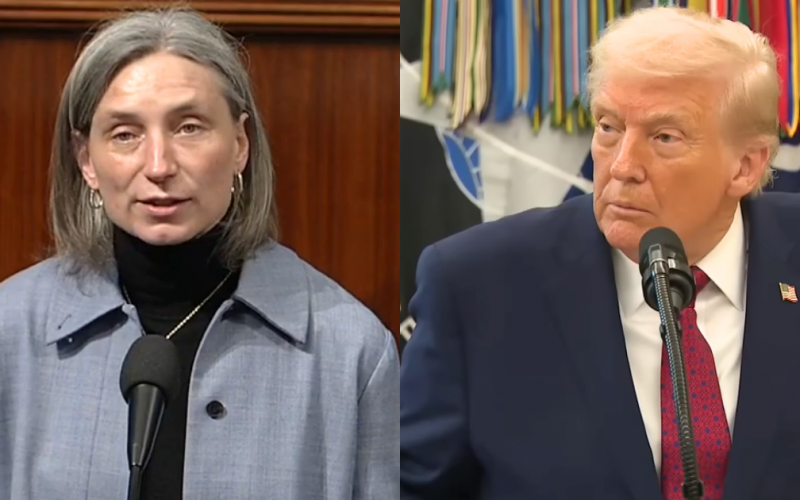
The return of whole milk to school cafeterias has ignited an unexpected political flashpoint, with one Democratic lawmaker accusing the Trump administration of promoting “white supremacy dog-whistling” through a federal nutrition policy change.
Oregon Rep. Maxine Dexter (D) made the claim during a town hall at Wy’east Middle School in Hood River while criticizing Health and Human Services Secretary Robert F. Kennedy Jr.
“Please ask for the science-based regimens,” Dexter said. “Not whatever RFK Jr. is getting kickbacks on or, you know, whatever whole milk, white supremacy dog-whistling that’s happening right now—I’m getting a little too political.”
Her remarks followed President Donald Trump’s signing of the Whole Milk for Healthy Kids Act of 2025, legislation restoring schools’ ability to offer whole and 2 percent milk under the federally regulated National School Lunch Program.
The change reverses restrictions implemented after the Healthy, Hunger-Free Kids Act of 2010, which aligned school meals with federal dietary guidelines that emphasized low-fat and fat-free dairy to reduce saturated fat intake.
Under the updated law, schools are permitted—not required—to serve whole milk.
Districts may continue offering low-fat, fat-free, or lactose-free options based on student needs and local discretion, according to U.S. Department of Agriculture guidance.
“I’m gonna start drinking a lot of milk,” Trump said as he signed the bill in the Oval Office, framing the move as part of a broader push to revisit federal dietary standards, BizPac Review noted.
The debate over dairy fat has evolved considerably since the Obama-era reforms.
For years, major health organizations recommended limiting saturated fat consumption, leading schools nationwide to remove whole milk from lunch lines.
However, more recent nutritional research has complicated that picture. Some studies have suggested full-fat dairy may not be linked to increased obesity risk in children and could offer benefits related to satiety and vitamin absorption.
The Associated Press has reported that growing scientific debate helped fuel bipartisan interest in reconsidering earlier restrictions.
Agriculture Secretary Brooke Rollins praised the shift.
“Thanks to President Trump’s leadership, whole milk is back—and it’s the right move for kids, for parents, and for America’s dairy farmers,” she said, according to Patriot Fetch.
Approximately 30 million students participate in the National School Lunch Program each year.
Dexter, a pulmonologist, has previously positioned herself as a vocal critic of Trump administration policies.
In another context, she declared, “Let me be clear: the big ugly betrayal bill will hurt people … This is not fiscal responsibility, it’s a smash and grab robbery of our healthcare system to give billionaires tax breaks.”
Her milk-related remarks drew scrutiny not only for their tone but also for reviving an argument that has circulated for years among certain activist circles—that federal milk guidelines disproportionately affect populations with higher rates of lactose intolerance.
While lactose intolerance does vary among ethnic groups, critics of Dexter’s framing argue that offering whole milk as one option among several does not mandate consumption and does not eliminate lactose-free alternatives.
Ultimately, the revised law does not require schools to eliminate existing options or compel students to choose whole milk.
It restores local discretion, allowing districts to determine which varieties best serve their student populations while remaining within federal nutrition standards.
The shift reflects a broader reassessment of long-standing dietary guidelines, as policymakers weigh newer research against earlier public health recommendations.
As federal agencies continue reviewing nutrition science and school meal standards, the debate over dairy fat may signal a larger conversation about how much flexibility states and local districts should have in administering national programs.
While critics view the change skeptically, supporters argue it represents an incremental adjustment rather than a sweeping overhaul—one that places decision-making closer to the communities directly affected.
WATCH:
