

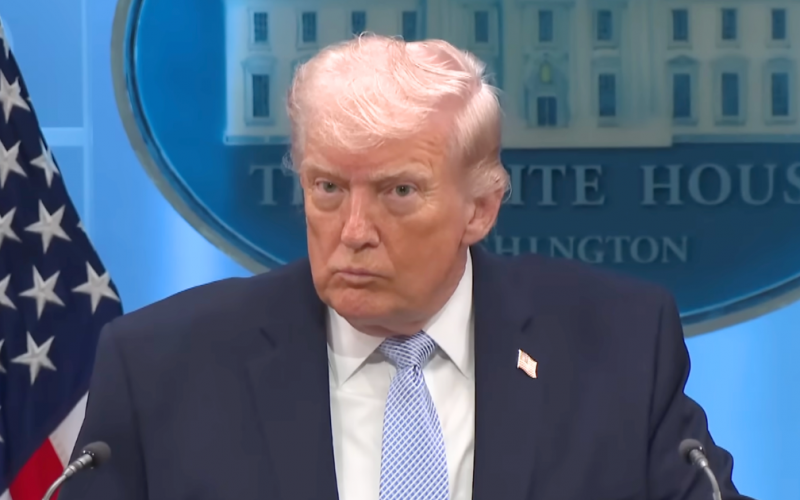
A federal judge has temporarily blocked President Donald Trump’s executive order restricting mail voting, dealing the administration another setback just days after the Supreme Court cleared the way for the policy to move forward.
U.S. District Judge Indira Talwani issued a 14-day hold Thursday preventing the federal government from implementing the order, according to the Associated Press. The ruling comes roughly one week before the first mail ballots are expected to be distributed ahead of the midterm elections.
The latest decision marks another turn in a rapidly changing legal fight that could ultimately return to the Supreme Court.
The high court on Monday overturned an earlier ruling from Talwani that had prevented Trump’s executive order from taking effect. However, the justices did not determine whether the order itself is constitutional.
Instead, the Supreme Court concluded that the challenges responsible for the earlier injunction had been filed prematurely, according to the Associated Press.
The administration has since issued a formal rule detailing how the U.S. Postal Service would implement the president’s directive, giving opponents a new basis to challenge the policy.
Under the Postal Service rule, states would be required to provide lists identifying voters who should receive mail ballots. Ballot envelopes would also have to meet specific formatting requirements before the Postal Service would deliver them.
Democrats and voting-rights organizations have challenged the requirements, arguing that the administration is attempting to exercise authority over elections that the Constitution assigns to states and Congress.
Election officials have also warned that there is insufficient time to overhaul their systems before the upcoming elections, particularly with mail voting already approaching.
Talwani cited those timing concerns in Thursday’s ruling, writing that states lack sufficient time and funding to redesign ballots, secure approval, manufacture new materials, modify election-management systems and train officials before the midterms.
The ruling precedes a Sept. 3 hearing after Democrats and voting-rights groups refiled their lawsuits following the Supreme Court’s decision.
Nearly one-third of Americans cast ballots through the mail, making the outcome of the legal battle potentially significant for election administrators across the country.
Trump signed the executive order in March as part of his administration’s broader effort to alter federal election procedures.
Opponents quickly sued, but the administration initially maintained that the challenges were premature because officials had not yet established the rules necessary to implement Trump’s directive.
That argument previously succeeded in a Washington, D.C., case. Talwani, an Obama-appointed judge in Massachusetts, separately issued injunctions preventing implementation of the order for the November midterms, per the New York Post.
After the Supreme Court struck down one of those holds Monday, Talwani removed the second injunction Wednesday.
The plaintiffs then refiled their cases following the Postal Service’s publication of its final rule, arguing that the circumstances underpinning the Supreme Court’s procedural decision had changed.
Thursday’s 14-day hold means the administration will once again have to wait before implementing the mail-ballot requirements while the renewed challenge proceeds.
The dispute is unlikely to end there. Given the rapid sequence of rulings and the approaching midterms, the case could soon find its way back before the Supreme Court.
