

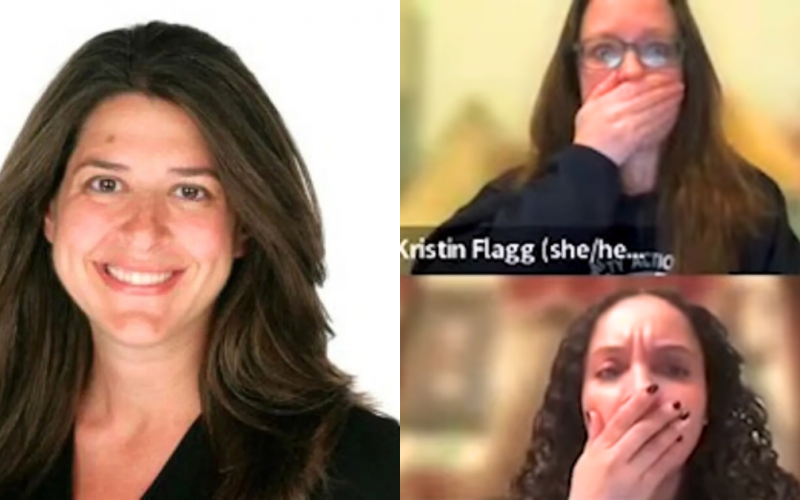
A Hunter College professor is under intense scrutiny after making racially charged remarks during a public meeting about potential school closures on Manhattan’s Upper West Side.
Allyson Friedman, an associate professor at Hunter College, reportedly made the comments on Feb. 10 while a black eighth-grade student spoke about the possible shutdown of her school.
“They’re too dumb to know they’re in a bad school,” Friedman said. “If you train a Black person well enough, they’ll know to use the back. You don’t have to tell them anymore.”
The remarks were audible to attendees both in person and online via Zoom, drawing immediate shock and disapproval.
Video from the meeting shows students and parents visibly reacting, with some covering their faces and others momentarily silent before continuing the discussion.
“Allyson Friedman, what you’re saying is absolutely hearable here. You’ve got to stop,” one participant reportedly interjected.
Friedman later sought to clarify, saying the comments were part of an attempt to illustrate systemic racism to her child, who was present at the meeting.
In a statement to Newsweek, she said, “During the February 10 CEC3 meeting, there was a discussion about systemic racism and educational equity, with references to Dr. Martin Luther King Jr. and the work of Carter G. Woodson, as well as school closures.”
“Separately, as a parent, I was trying to explain the concept of systemic racism by referencing a historical example. Due to an inadvertent unmute, part of that conversation was captured.”
“My remarks were not directed at the student speaker, and they do not reflect my beliefs or values. Regardless of context, my words were wrong and caused real harm. I take full responsibility for their impact, and I am deeply sorry to the students, families, educators, and community members who were hurt,” Friedman added, noting she sent written apologies to the school and council officials.
Hunter College confirmed it is reviewing the incident under the university’s conduct and nondiscrimination policies.
Senior Vice President Peter Englot stated, “Even as these remarks were made in the individual’s role as a private citizen and we understand that the district is conducting an investigation, Hunter College is reviewing the situation under applicable conduct and nondiscrimination policies. We expect our community members’ actions and words to comport with our institutional identity, values, and policies.”
The comments occurred during a New York City School District 3 Community Education Council meeting (CEC3), convened to discuss proposals that could close or relocate multiple local schools, including the Community Action School, the Manhattan School for Children, and the Center School.
NY Daily News reported that some schools are at risk of losing middle school grades due to low enrollment, raising concern among parents and students.
Public officials responded swiftly.
City Council Education Chair Rita Joseph called the remarks “blatantly racist and harmful,” according to The Independent.
She added that they reveal “a deeper and enduring issue within our New York City public school system: systemic racism that continues to show up in policies, practices, and as we saw, in rhetoric.”
Ken Samuels, Chancellor of New York City Public Schools, emphasized that racism will not be tolerated in city schools.
“Citywide and Community Education Councils are independent bodies, and their meetings are expected to be respectful spaces for students, families, and staff. What happened at the meeting was a complete violation of those expectations,” he said.
Parents and advocacy groups warned the incident could affect student well-being.
The Center School PTA said, “We want to be absolutely clear: this parent’s statement does not represent the values of the Center School community. Yet their words remind us that racism is not distant—it exists in our broader community, and it is our collective responsibility to confront it.”
The episode underscores the challenges public schools face in ensuring inclusive environments while managing administrative decisions such as school closures, highlighting the tension between educational policy and community trust.
WATCH:
