

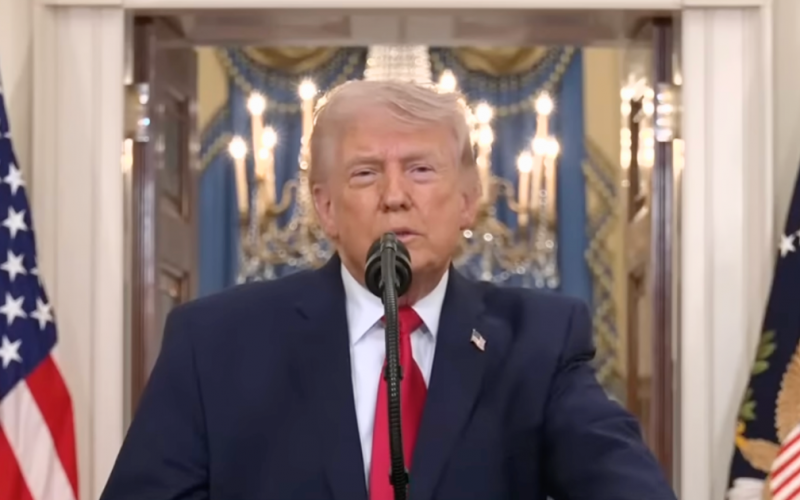
Global markets were thrown into turmoil after President Donald Trump delivered a prime-time address on the Iran war that failed to provide a clear path forward.
Oil prices surged immediately following the speech, with Brent crude jumping nearly 5% to $105 per barrel as uncertainty gripped investors.
At the same time, U.S. futures dropped sharply.
The Dow fell 1%, the S&P 500 declined 1.1%, and the Nasdaq slid 1.4%, signaling broad concern across financial markets.
International markets reacted just as strongly.
Japan’s Nikkei index dropped 1.9%, one of the first major indicators of global investor sentiment after U.S. trading hours.
The reaction was driven largely by what the speech did not include.
Trump declared the war a success but acknowledged that U.S. involvement would continue for at least two to three more weeks.
He did not outline a concrete exit strategy or provide clear assurances about stabilizing the situation.
That lack of clarity sent shockwaves through markets already sensitive to the conflict.
Energy prices remain at the center of the issue.
The national average for gas has climbed to $4.06 per gallon, up significantly from pre-war levels of around $2.90.
Trump addressed the spike directly, blaming Iran for the increase.
“This short-term increase has been entirely the result of the Iranian regime launching terror attacks,” Trump said, pointing to strikes on oil tankers and regional infrastructure.
The Strait of Hormuz remains a critical flashpoint.
Roughly 20% of the world’s oil supply moves through the waterway, which has been heavily disrupted since the conflict began, per the Daily Mail.
Despite its importance, Trump offered little reassurance about reopening the route.
Instead, he shifted responsibility to other nations.
“The countries of the world that receive oil through the Hormuz Strait must take care of that passage,” he said.
He went further, urging allies to take direct action.
“Go to the Strait and just take it,” Trump added, suggesting other countries should lead efforts to secure the route.
That stance raised concerns among analysts, who expected clearer leadership from the United States.
The speech also avoided several key topics.
There was no mention of deploying U.S. ground troops or a detailed plan involving NATO allies.
That omission added to the uncertainty surrounding the administration’s next steps.
Meanwhile, military activity in the region continues to increase.
Additional U.S. naval forces, including amphibious assault ships and thousands of troops, are being deployed to the Middle East.
Allies in the region are also weighing their options.
The United Arab Emirates has reportedly considered sending forces to help secure the Strait of Hormuz, while some European nations remain hesitant to escalate involvement.
The market response highlights the broader impact of the conflict.
Investors are reacting not just to the war itself, but to the lack of a clear resolution.
