

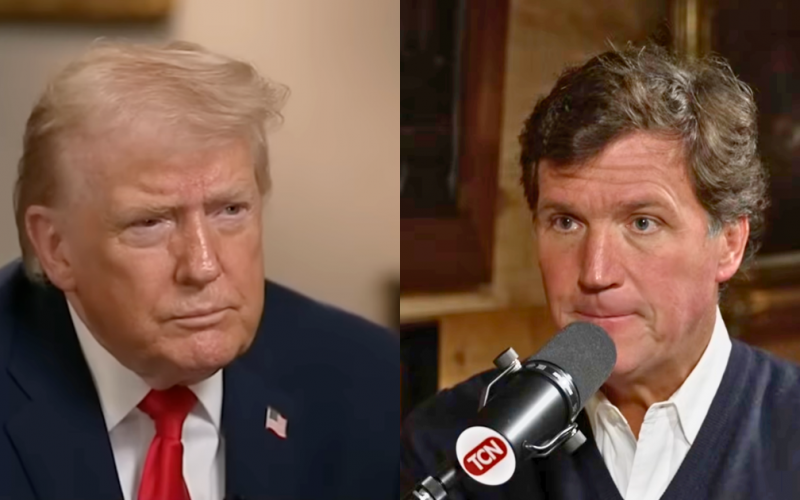
Conservative commentator Tucker Carlson sharply criticized President Donald Trump’s military strikes on Iran, describing the operation as “absolutely disgusting and evil.”
Carlson made the remarks in comments to journalist Jon Karl following the U.S. military’s joint operation with Israel targeting Iranian leadership, missile systems and military infrastructure.
The criticism marks a rare public break between Carlson and President Trump.
Just one week earlier, Carlson met with President Trump in the Oval Office, where he reportedly urged him not to pursue military action against Iran.
President Trump built much of his political identity around opposition to prolonged regime-change wars in the Middle East.
Carlson has frequently praised the president in the past for exercising restraint in foreign conflicts.
The U.S. launched Operation Epic Fury in coordination with Israel, deploying Tomahawk missiles along with Air Force and Navy aircraft against targets across Iran.
Iran responded with missile strikes aimed at U.S. military bases in the region. Tehran claimed it struck the Fifth Fleet service center in Manama, Bahrain, and targeted installations in Qatar, the United Arab Emirates and Kuwait.
Regional governments reported missile and drone activity, though full casualty assessments remain unclear.
President Trump acknowledged the risks of the operation in a public address, stating that U.S. forces “may have casualties.”
Carlson’s criticism has drawn attention within conservative circles, where debate is emerging over the direction of U.S. foreign policy.
Carlson campaigned for President Trump during the 2024 election cycle and spoke in support of him at major events, including the Republican National Convention.
He is also widely viewed as a political ally of Vice President J.D. Vance, according to the Daily Mail.
Former Rep. Marjorie Taylor Greene (R-GA) also voiced opposition to the strikes, arguing that voters supported President Trump in part because of his opposition to foreign wars.
In a statement, she questioned whether the U.S. should be involved in efforts to “free” Iran, writing that Iranians should determine their own political future.
The debate intensified after Carlson recently interviewed U.S. Ambassador to Israel Mike Huckabee, where the two discussed Middle East policy and Israel’s security posture.
Huckabee’s comments during that exchange drew criticism from several Gulf nations.
The White House has defended the operation as necessary to prevent Iran from obtaining nuclear weapons and to neutralize imminent threats.
As Operation Epic Fury continues, the political ramifications at home are becoming increasingly visible.
While President Trump maintains support among many Republicans, Carlson’s public rebuke underscores divisions within segments of the conservative base over military engagement in the Middle East.
