

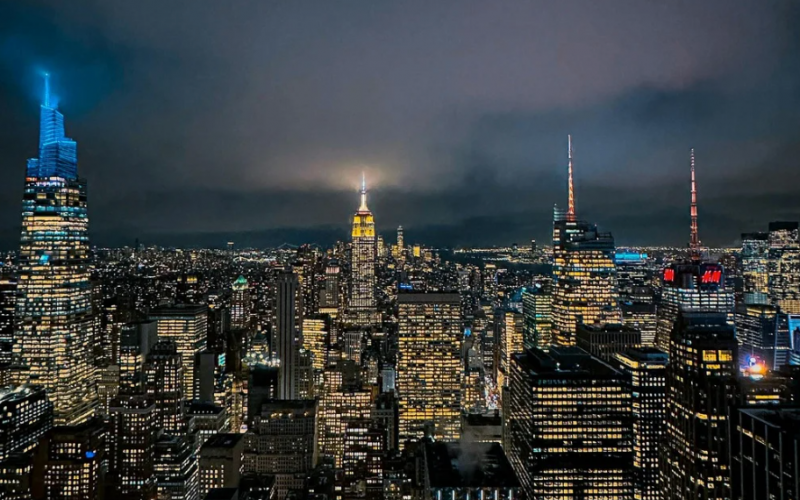
A sitting New York State lawmaker wants to pull the plug on New York City’s famous glow — and if the bill passes, some of the most recognizable skylines in the world could go dark nightly before midnight.
Manhattan Assemblywoman Deborah Glick authored the “Dark Skies Protection Act,” a piece of legislation that targets what supporters describe as runaway artificial light consumption across the state’s most densely populated city.
The bill carries an effective date of 2028, giving businesses and property owners several years to comply if the measure clears the legislature and earns a gubernatorial signature.
Under the proposal, non-essential lighting inside businesses and residential buildings would face a mandatory shutdown window stretching from 11 p.m. to 5 a.m. each night.
The legislation does carve out exceptions.
Lighting tied directly to public safety and transportation would remain protected under the bill’s language and would not fall under the shutdown requirement.
Glick’s office frames the proposal around three central goals: slashing energy consumption, reducing light pollution across the state, and shielding migratory birds from the dangers posed by bright urban environments.
The bill leans on a striking statistic to make its environmental case. According to the legislation’s own text, eight out of ten Americans have lost the ability to see the Milky Way with the naked eye due to the spread of artificial light.
Human health also appears in the bill’s findings. The legislation warns that prolonged exposure to excess artificial light carries the potential to disrupt circadian rhythms — producing downstream effects on hormone output, brain wave activity, and cellular function.
Wildlife conservationists have long sounded alarms about nighttime lighting in major cities.
The bill references data showing that seventy percent of bird species make annual migrations, with roughly eighty percent of those birds traveling after dark and relying on natural sky patterns to stay on course.
City lights, the bill argues, throw those birds off course — sometimes fatally — as disoriented animals fly into glass buildings and other structures.
Not everyone in Albany is on board. Gerard Kassar, chairman of the New York State Conservative Party, unloaded on the proposal in remarks to the New York Post.
“I guess Glick wants to push one last ridiculous idea before she retires,” Kassar said.
The retirement reference was pointed. Glick has publicly announced she will not seek another term, raising questions among critics about the political motivation behind introducing sweeping legislation in her final stretch in office.
Opposition voices have zeroed in on public safety as their primary concern. Detractors argue that darkening city streets and buildings overnight creates conditions favorable to theft, gang activity, and other crimes that thrive in low-visibility environments.
The Post further noted that Glick has downplayed the enforcement teeth of the measure. She has stated publicly that no fines are attached to the bill, and characterized the effort as a push for the state’s Department of Environmental Conservation to develop and distribute educational materials around light usage.
The legislation cleared the Environmental Conservation Committee with a 20 to 9 vote, but currently lacks a full sponsor in the New York State Senate — a gap that leaves its future path to passage unclear.
