

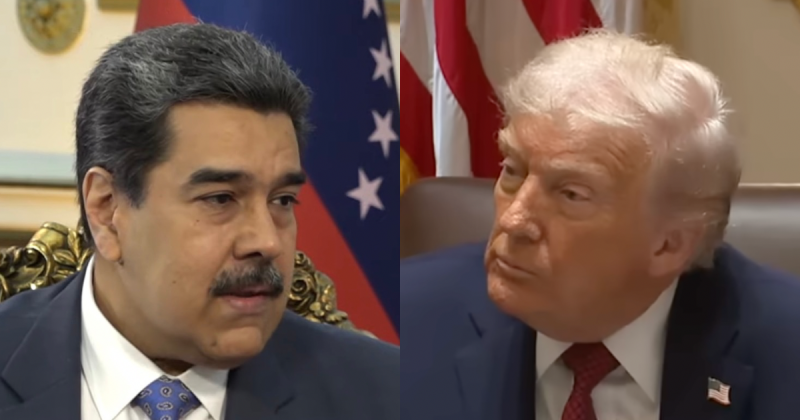
The U.S. launched a large-scale military operation against Venezuela early Saturday, with President Donald Trump claiming the U.S. military captured Venezuelan President Nicolás Maduro and his wife, dramatically escalating tensions in Latin America.
In a Truth Social post shortly after 4:30 a.m. ET, Trump said the operation was successfully executed and that Maduro and First Lady Cilia Flores were captured and flown out of the country.
He described the mission as a joint effort involving the U.S. military and U.S. law enforcement and announced a press conference later in the day at Mar-a-Lago.
Trump framed the operation as a decisive strike against what his administration has long labeled a narco-terrorist regime, accusing Maduro’s government of drug trafficking, corruption, and violent repression. Maduro has consistently denied those allegations.
Multiple explosions were reported overnight in and around Caracas, with additional strikes hitting areas in Miranda, Aragua, and La Guaira. Residents described hearing at least seven blasts, while videos circulating online showed low-flying aircraft and flashes in the night sky, triggering panic across the capital.
Venezuela’s government immediately condemned the strikes as military aggression and declared a state of emergency, calling on security forces and civilians to mobilize.
Officials accused the U.S. of violating Venezuelan sovereignty and attempting to seize control of the country’s strategic resources, including oil.
Vice President Delcy Rodríguez said authorities did not know Maduro’s whereabouts and demanded proof of life, warning that Venezuela’s constitution provides a succession process if the president is incapacitated or removed, per CBS News.
As of early Saturday, it remained unclear who was exercising effective control of the government.
International reaction was swift and divided.
Some governments condemned the U.S. action as a violation of international law, while others warned the strikes could destabilize the region and spark a humanitarian crisis. Several countries urged restraint and called for emergency diplomatic talks.
The Federal Aviation Administration banned U.S. commercial flights over Venezuelan airspace due to ongoing military activity.
U.S. citizens in Venezuela were advised to shelter in place as conditions remained volatile.
In Washington, legal and political questions quickly emerged. It was not immediately clear whether Congress had formally authorized the military action or what specific legal authority the administration relied upon.
Lawmakers from both parties began debating the scope of presidential war powers and the long-term consequences of direct military intervention.
While independent verification of Maduro’s capture remained limited at the time of reporting, Trump’s announcement marks one of the most dramatic U.S. military actions in the Western Hemisphere in decades.
The situation remains fluid, with global attention focused on what comes next for Venezuela, the region, and U.S. foreign policy.
