

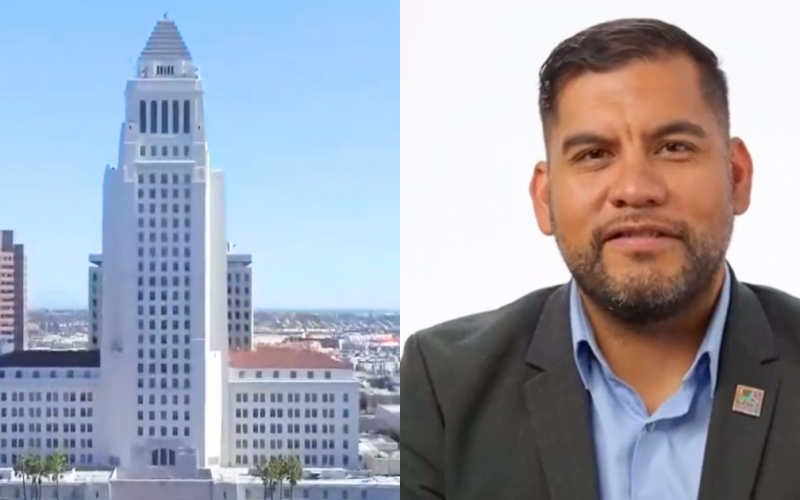
A proposal moving through Los Angeles City Hall is reigniting a longstanding debate over how local democracy defines participation, as city officials consider whether noncitizens could eventually be granted access to the ballot in municipal elections.
The measure, introduced by Los Angeles City Councilmember Hugo Soto-Martínez, would place the question before voters in the Nov. 3 election: whether the City Council should be authorized to extend voting rights in city races—including contests for mayor, City Council, and the Los Angeles Board of Education—to noncitizens.
Before it could reach the ballot, the proposal must first clear multiple procedural steps, including committee review and a vote by the full city council.
Even if voters were to approve it, city officials would still be required to adopt a formal ordinance rewriting election rules to put the policy into effect, according to LifeZette.
Councilmember Ysabel Jurado has signed onto the proposal, which is now scheduled to advance through the council’s rules committee for initial consideration before any broader debate at City Hall.
Soto-Martínez has pointed to his personal background in defending the proposal, citing his parents’ experience as immigrants who worked, paid taxes, and raised children in public schools while lacking a formal vote in local governance until becoming citizens.
Supporters of expanding noncitizen participation in local elections have also emerged in other political contests across the city, with some candidates and elected officials signaling openness to broader eligibility rules for municipal voting.
Opposition to the proposal has centered on concerns about the relationship between citizenship and voting rights, with critics arguing the change would alter a foundational structure of American civic participation.
Ira Mehlman, spokesperson for the Federation for American Immigration Reform, said the effort challenges that framework, arguing it “undermines the whole concept of citizenship, and what it means to be a member of American society.”
He further argued that voting is inherently tied to citizenship status and warned against expanding electoral participation to individuals who are not formal members of the political community.
Concerns have also been raised by political opponents within Los Angeles, including Dylan Kendall, who warned the proposal could have unintended consequences for noncitizens themselves, Newsmax reported.
Kendall said the measure risks increasing exposure for vulnerable communities by creating identifiable records of noncitizen participation in elections at a time of heightened immigration enforcement.
She also described the potential system as effectively forming a publicly accessible “government list” of noncitizen voters, raising concerns about how such information could be used.
The Los Angeles proposal is part of a broader national patchwork of local experiments and legal battles over noncitizen voting eligibility.
A comparable policy in New York City had been adopted locally but was ultimately invalidated by the state’s top court.
Within California, some jurisdictions have already implemented limited forms of noncitizen voting, including participation in San Francisco school board elections, while Oakland voters approved a comparable measure in 2022 that has yet to be fully implemented.
Other cities have moved in the opposite direction. In Santa Ana, voters rejected a noncitizen voting proposal in 2024.
If ultimately approved and implemented, Los Angeles would become the largest city in the United States to extend voting rights to noncitizens in local elections, marking a significant expansion of municipal electoral eligibility.
For now, the proposal remains in the early stages of the legislative process, with committee discussions and council deliberations expected to determine whether it advances to the ballot or stalls before reaching voters.
WATCH:
