

Washington, D.C. could be looking at nearly four more years of National Guard boots on the ground, according to a newly finalized Pentagon timeline that stretches all the way to the final day of President Trump’s second term.
Two officials briefed on the matter told ABC News that the extension plan was completed in the closing weeks of last year. It now requires only one more signature to take effect: that of War Secretary Pete Hegseth.
Sources close to the process say approval from Hegseth is all but assured, though no formal sign-off has been announced publicly.
Pentagon spokeswoman Kingsley Wilson kept her comments brief when pressed on the matter, telling reporters there were “no announcements to make at this time.”
Wilson left little doubt about the administration’s underlying priorities, however, framing the ongoing troop presence as part of a broader campaign. The Defense Department, she said, remains “committed to supporting the President’s mission to address the epidemic of crime in our Nation’s capital.”
Behind the bureaucratic language lies a mission with a name: “Make D.C. Safe and Beautiful,” also referred to as the “D.C. Safe and Beautiful Mission.” It has been running since guard units first arrived in the city in August 2025.
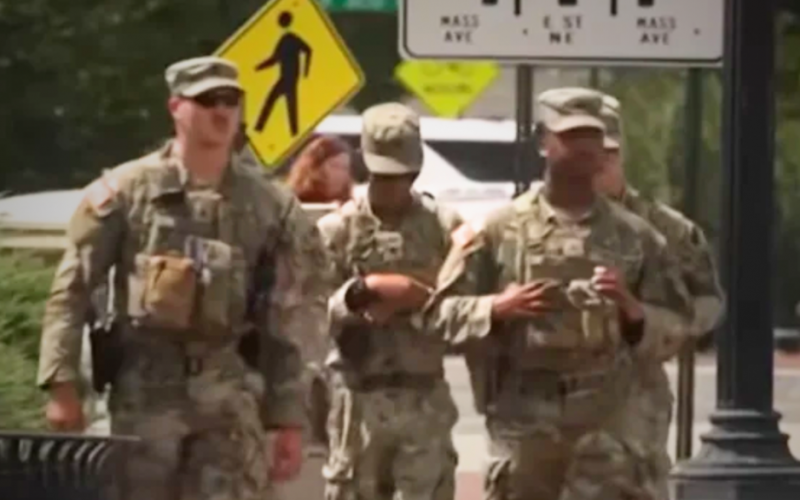
Nearly a year later, the scope of the operation has expanded well beyond simple street patrols. Guard members now assist Metropolitan Police with routine safety operations, direct traffic in congested corridors, and stand watch over the city’s most prominent monuments.
Federal buildings have also fallen under the umbrella of guard protection. On top of security duties, troops have logged hours on cleanup projects across the district, picking up litter, maintaining green spaces, and scrubbing away graffiti.
The result has been a near-constant military footprint in some of the city’s busiest public spaces. Commuters passing through Metro stations, tourists wandering downtown, and visitors to the National Mall have all grown accustomed to the sight of uniformed guard members.
A spokesperson for Joint Task Force D.C. summed up the operation’s priorities directly: “The D.C. National Guard remains focused on its mission assisting the Metropolitan Police Department and federal partners with monument security, community safety patrols, and the protection of federal facilities. Our Soldiers continue to provide traffic control and area beautification to safeguard District residents and visitors.”
That same spokesperson pointed out that the Pentagon isn’t limited to current troop levels. Additional forces can be mobilized at any time, provided the move is coordinated with the governors of the states supplying personnel.
Counting exactly how many troops are involved has proven tricky, as estimates have shifted throughout the mission’s run. ABC News reported a figure near 2,865 service members as of March 2026.
The bulk of those troops hail from GOP-led states, with Florida, Georgia, South Carolina, and Oklahoma among the top contributors, working in rotation alongside D.C.’s own Guard units. Deployment schedules have been staggered rather than uniform.
Not every estimate has matched ABC’s number. Some tallies have put the figure closer to 2,600, while others describe totals surpassing 5,000 during particular stretches of the mission.
Length of service has also varied dramatically from soldier to soldier. A portion of the deployed troops have stayed in the capital almost without interruption since the mission’s earliest days, while others have completed brief rotational stints before heading home.
Rewind to the beginning, and the numbers looked far smaller.
Trump’s original order in August 2025 sent about 800 D.C. Guard members into the city, a deployment that was later stretched through the close of 2026 before this newest extension entered the picture.
Whatever the eventual troop count, the district’s own crime statistics suggest a shift is underway. Metropolitan Police data covering the year through early July 2026 shows total crime down 21 percent compared to the same stretch the year before.
Property crime fell even further, down 23 percent year-over-year, while motor vehicle theft dropped sharply as well.
Robbery figures also declined within the department’s broader dataset, adding to a pattern of falling numbers across multiple crime categories tracked by police.
Should Hegseth give his expected approval, the guard’s presence in the capital would remain locked in place through January 20, 2029, spanning the entirety of Trump’s remaining time in office.
