

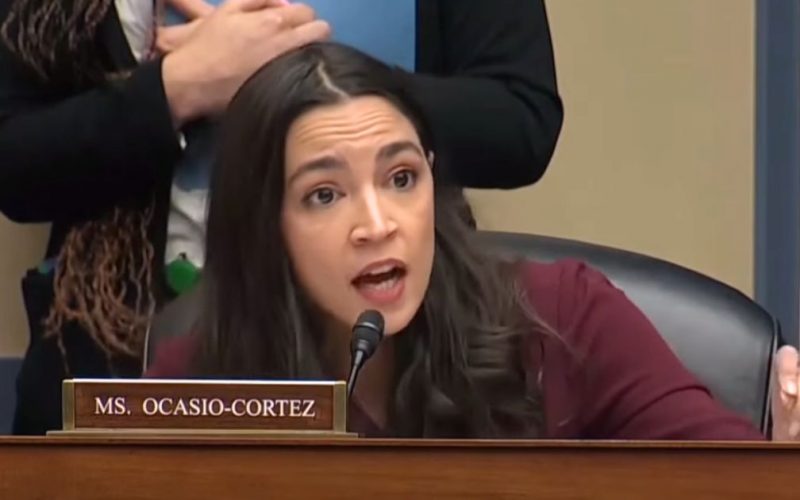
Rep. Alexandria Ocasio-Cortez (D-NY) traveled to Munich, Germany last week to make her mark on the world stage at the 62nd Annual Munich Security Conference — but a halting, 40-second answer on whether the United States should defend Taiwan against China stole the headlines and drew sharp criticism from Republicans and Democrats alike.
Bloomberg Television anchor Francine Lacqua posed the direct question to the New York Democrat during one of two panel appearances at the prestigious forum: “Would and should the U.S. actually commit U.S. troops to defend Taiwan if China were to move?”
Ocasio-Cortez paused for nearly 20 seconds before responding.
“Um, you know, I think that this is such a, you know, I think that this is, this is of course a very longstanding policy of the United States,” she said, struggling to complete her thought.
“What we are hoping for is that we want to make sure that we never get to that point,” she added.
She then continued, “And we want to make sure that we are moving in all of our economic research and our global positions to avoid any such confrontation, and for that question to even arise.”
At no point did the congresswoman state whether American troops should or should not be deployed in defense of Taiwan.
Beijing has long claimed sovereignty over Taiwan, a self-governing island that maintains its own military, currency, and democratic government.
In December, China staged sweeping military exercises encircling Taiwan, which U.S. officials viewed as a potential rehearsal for future military action, according to reports.
Chinese authorities called the drills a “stern warning” following the Trump administration’s approval of an $11 billion arms package for Taipei.
For decades, U.S. policy toward Taiwan has operated under a framework of strategic ambiguity — neither explicitly guaranteeing military intervention nor abandoning the island’s defense.
Ocasio-Cortez, 36, participated in two panel discussions at the Munich conference.
One panel focused on the global rise of populism; the other addressed major shifts in American foreign policy.
On the foreign policy panel, she also faltered when asked to name the single biggest shift in U.S. foreign policy under President Trump.
“The single-biggest?” she said, asking for clarification and laughing lightly.
She then steered toward a broader discussion spanning multiple administrations.
“Well, I think zooming out beyond just this presidential administration,” Ocasio-Cortez said.
“I think that what we are seeing is, between President Trump’s first administration pulling out of long-standing international agreements; then you have President Biden, who is opting back into some of them, such as, for example, with the Paris Climate Accords, and then you have President Trump that’s elected again, I think what we are seeing now is this idea that US foreign policy is, and some of our more basic and foundational values-based commitments seem to be enacted based on the partisanship of whoever is elected,” she continued.
She added that President Trump has played “hokey-pokey” with “many of our commitments,” including foreign aid and the Paris agreement.
The conference, billed as the world’s leading forum for international security policy, drew heads of state, defense ministers and security officials from across the globe.
Several Democrats widely seen as potential 2028 presidential contenders also attended, including California Gov. Gavin Newsom, Michigan Gov. Gretchen Whitmer, and Sens. Mark Kelly, Chris Murphy, Elissa Slotkin, and Ruben Gallego.
The congresswoman’s Munich appearance drew a divided reaction even within her own party.
WATCH:
