

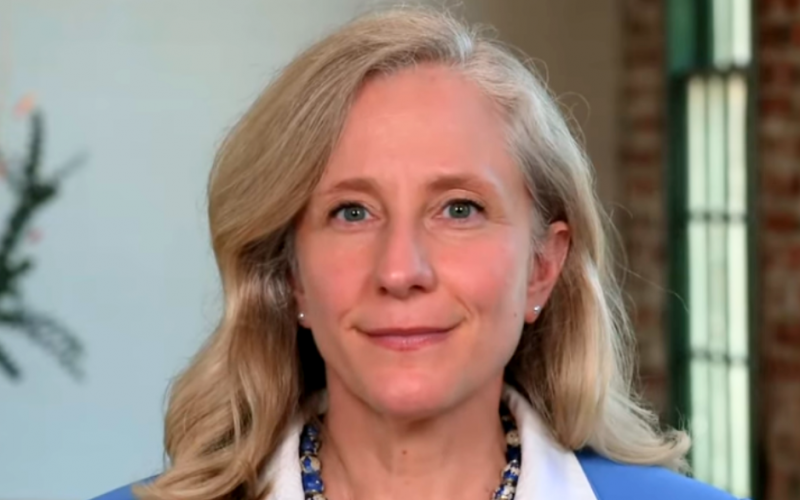
A political storm is swirling across Virginia as Republicans charge that Gov. Abigail Spanberger abandoned a pledge she made to voters, having previously declared she had “no plans” to pursue a redrawing of the state’s congressional districts — a map she now actively champions.
The referendum, which came before voters Tuesday, would dismantle Virginia’s current 6-5 Democratic congressional alignment and replace it with a 10-1 Democratic supermajority map engineered by Senate President L. Louise Lucas of Portsmouth.
Del. Michael Webert, a Republican from Fauquier County, put it bluntly. “Behold the great bait and switch,” he said, circulating an October news report that captured Spanberger’s earlier position — one that now stands in stark contrast to her current role as the referendum’s most prominent backer.
Webert’s district sits at a geographic and political fault line — wedged between the Washington, D.C. suburbs poised to accumulate power under the new map and the sprawling rural communities stretching south and west that opponents say would be effectively silenced.
Former Govs. George Allen and Glenn Youngkin have joined a broad conservative coalition opposing the measure, lending high-profile voices to a campaign that has gained traction in the commonwealth’s more rural precincts.
U.S. Rep. Ben Cline, whose district winds along the Blue Ridge Mountains and through the Shenandoah Valley from Roanoke all the way to the West Virginia line near Berryville, has emerged as one of the referendum’s most pointed critics.
Cline told Fox News Digital that Spanberger, once a fellow member of the House Agriculture Committee, made a habit of touting her connection to Virginia’s farming communities.
“My district is currently the most agriculture-based district in Virginia and she has chopped it into five different districts and parceled it out to Northern Virginia Democrats to use to make their numbers work,” he said, calling the move an affront to Virginia farmers.
In separate remarks, Cline described his constituents as being carved into five “spaghetti strands” all tracing back to the suburbs of Arlington and Fairfax — a restructuring he said would rob the region of whatever unified voice it currently holds in Washington.
Spanberger had featured prominently in a multi-million-dollar advertising push behind the referendum. Virginia Scope reported that the ad was pulled from the airwaves.
“They’ve pulled her ad from even running, yeah, because she’s so unpopular,” Cline said. “[The situation] slid south for her and that’s what happens when you play bait-and-switch with the voters.”
The Vote YES campaign fired back in a statement to Fox News Digital. “This is false,” the campaign said. “We’re running a strong statewide campaign featuring a range of voices — including Governor Spanberger. This election is about stopping Trump’s power grab and leveling the playing field — and that’s exactly what a YES vote does.”
Cline also raised the fact that multiple Fairfax-area Democrats had already begun competing for a redrawn seat that has not yet officially come into existence — a seat that would consume large portions of his current district.
He singled out Del. Dan Helmer, a Fairfax Democrat who helped design the redistricting effort.
“I didn’t think Dan Helmer could find Shenandoah Valley on a map, but yet he’s going to be campaigning and asking for votes [here],” Cline said. Helmer, a combat veteran, also authored a sweeping firearms measure that opponents branded a “gun grab.”
Del. Joe McNamara, a Republican from Roanoke, told the Virginia Mercury that the situation amounted to lawmakers crafting policy in their own electoral interest.
“They’re enacting laws to help them get elected to Congress, not enacting laws to help Virginians get ahead,” McNamara said of Helmer’s dual role as map designer and candidate.
Helmer declined to apologize. “I’ve campaigned in every corner of this district — from Rockingham to Louisa, Arlington to Powhatan.
Because of those efforts, 14 MAGA Republicans [in the state legislature] are now unemployed and doom scrolling LinkedIn instead of harming Virginia families — and this November, we’re going to add Ben Cline to that list,” he told Fox News Digital.
Former first lady Dorothy McAuliffe and JP Cooney — a onetime aide to special counsel Jack Smith — are among the other Democrats who have entered the race for the not-yet-confirmed redrawn district.
Of the new proposed congressional map, only Rep. Morgan Griffith’s district would survive as a Republican-held seat.
House Minority Leader Terry Kilgore has been stumping across far southwestern Virginia alongside Youngkin and former Attorney General Jason Miyares, urging residents to head to the polls.
In Dickenson County — home of the late bluegrass legend Ralph Stanley — Kilgore joined local leaders in a turnout push. State Sen. Todd Pillion reported that 500 residents had already cast early ballots that day in the sparsely populated county.
“We just want everybody to vote ‘No,’” Kilgore said. “We do not want Fairfax County controlling our congressional districts and we want to protect rural Virginia.”
Rep. Rob Wittman of the Northern Neck sounded a similar alarm. “Governor Spanberger said it clearly: ‘I have no plans to redistrict Virginia’. But now, Richmond politicians are pushing a referendum to do exactly that—redraw congressional maps in the middle of the decade,” Wittman said. “A 10-1 map would erase millions of voices – that’s not representation; that’s partisan gerrymandering.”
The referendum’s path to the ballot has not been without legal turbulence.
Tazewell County Circuit Court Judge Jack Hurley issued an injunction halting the referendum, ruling that the official ballot description — which used the phrase “restore fairness” — was unconstitutionally misleading.
Hurley ruled that the language “would lead a voter to believe he or she were doing something unfair by voting against the proposed amendment.”
The Virginia Supreme Court subsequently intervened and allowed the vote to proceed.
Both sides in the legal challenge were due to file arguments Thursday on the underlying merits, with the court set to determine whether any result from the referendum would ultimately be undone.
