

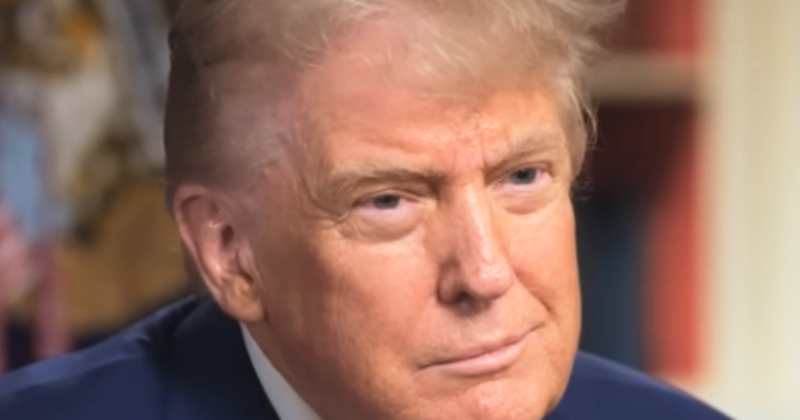
Donald Trump says he hopes to reach heaven. He also says he will not pretend to forgive his rivals to get there.
The president staked out both positions in a sit-down with interviewer Ross Douthat.
Douthat built a thought experiment around the afterlife and aimed it at two of Trump’s best-known political adversaries.
The conversation began with Trump’s own expectations. Douthat asked whether the president thought he would go to heaven. “I hope so. I don’t want to go to hell,” Trump said.
Trump then described his faith. “I’m a religious person so, in theory, I go to heaven,” he said.
Later, Douthat put the hypothetical to him.
He told Trump that the only requirement for entering paradise was feeling love and forgiveness toward former FBI Director James Comey, former House Speaker Nancy Pelosi and anyone else Trump has criticized over the years.
“Do you think you can do it?” Douthat asked.
Trump said a tidy reply sat within easy reach. Answering yes, he told Douthat, would be the “easy answer.” He declined to give it.
“I don’t think it’s an easy question,” Trump said.
He then explained how he sees the two figures.
“I found them to be extremely dishonest people. Very bad people. Very bad for our country,” he said. Trump continued: “I love our country far more than I can love people and people like that.”
Douthat asked whether that meant his answer was no.
“The answer is no. I want to be honest,” Trump replied.
The interviewer raised the stakes by moving the scene to the highest court imaginable, asking whether Trump would say no before the “judgment throne of God.”
Trump confirmed that he would. “Before the judgment,” he said.
The president kept going, and he chose the strongest word available.
“I think they were very bad people and I dislike, I can use the word hate, I do hate some of my enemies. I think they’re they’ve been terrible. Look what they put me through, the weaponization-” he said.
He never finished the thought. Douthat cut in to remind Trump of his good fortune, describing his life as the “most charmed and remarkable life of any American in my entire lifetime.”
Douthat then pressed harder.
“You are telling me that before the judgment throne of God, you couldn’t find it in your heart to forgive some of your enemies?” he asked. “After all that’s been given to you? Come on, help me out here.”
Trump held his ground. He said that answering yes would be untruthful, then delivered his verdict with a stern expression.
“Can I be honest? I probably cannot do that, no, because I do hate some of my enemies and I always will,” he said.
The president’s history with each person named in the question is well documented.
His frustration with Comey traces to the FBI’s probe of alleged ties between Trump and Russia during his first term in office.
Pelosi was the Speaker who spearheaded the House’s two impeachments of Trump during that same first term, in 2019 and 2021.
Douthat eventually steered the interview toward Trump’s legacy. He asked the president to sum up in one short phrase what his presidency should be remembered for a century from now.
His question carried a playful jab, referring to Trump “working out your situation in purgatory.”
Trump needed only a single sentence. “That I made America great again,” he said.
