

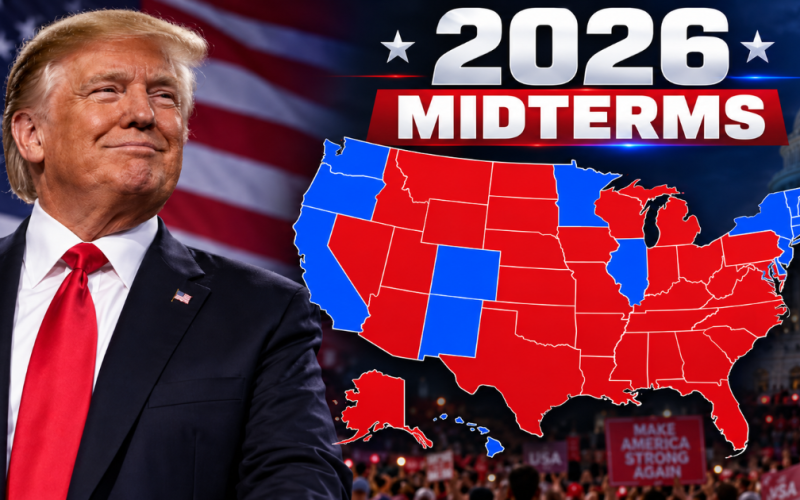
With the November 3 midterm elections just days away, Republicans are seeing encouraging signs in several closely watched Senate races, as new polling shows GOP candidates pulling ahead of their Democratic opponents in states that could determine control of Congress.
Fresh surveys in Texas, Kansas, Iowa, Michigan and Ohio have given Republicans narrow leads, although conflicting results from other pollsters suggest several contests remain too close to call.
The stakes are substantial. Republicans currently hold a 53-47 majority in the U.S. Senate, and even modest shifts in a handful of competitive races could change the chamber’s balance of power.
One of the most closely watched developments comes from Texas, where Republican Ken Paxton has gained ground against Democrat James Talarico.
A new InsiderAdvantage survey of 1,200 likely voters found Paxton leading Talarico 49% to 48%, a one-point advantage within the poll’s 2.8-point margin of error.
The result represents a shift from several previous surveys that placed Talarico ahead.
However, the broader polling picture remains mixed. The RealClearPolitics average still shows Talarico leading 48.5% to 46.3%, while a CBS News survey found the Democrat ahead 51% to 49%.
Texas is not the only state where Republicans have received favorable numbers.
In Kansas, incumbent Republican Sen. Roger Marshall holds a narrow 48% to 47% lead over Democratic challenger Adam Hamilton in the latest InsiderAdvantage survey.
That result helped move Marshall slightly ahead in the RealClearPolitics average, where he leads 46% to 45.7%.
The competitiveness of the Kansas race is particularly notable given the state’s political history. Kansas has not elected a Democratic U.S. senator in more than 90 years.
President Donald Trump recently traveled to the state to campaign for Marshall, seeking to reinforce Republican support in a state he carried by approximately 16 percentage points in the 2024 presidential election.
Meanwhile, Michigan has delivered another potentially significant development for Republicans.
A new Tyson Group survey found Republican Mike Rogers leading Democrat Abdul El-Sayed 46% to 44%.
According to the polling firm’s announcement, Rogers gained three percentage points compared with its previous statewide survey.
The two-point advantage provides a boost for the Republican candidate as both parties compete for a Senate seat in a state that has become a major political battleground.
In Iowa, Republican Rep. Ashley Hinson is also leading in several recent surveys as she competes against Democrat Josh Turek for the seat being vacated by retiring Republican Sen. Joni Ernst.
An October 19 co/efficient poll found Hinson ahead 48% to 45%.
A Trafalgar Group survey conducted October 13-15 similarly showed Hinson leading 45.9% to 44.2%.
Other surveys from Emerson College and CNN also placed Hinson narrowly ahead.
However, Marist and YouGov polls have shown Turek with slim advantages, highlighting the uncertainty surrounding the contest.
Ohio offers a similarly divided polling picture.
Republican Sen. Jon Husted, who is facing former Democratic Sen. Sherrod Brown, received a two-point advantage in a recent Rasmussen Reports survey, leading 49% to 47%.
An October 18 ActiVote poll showed an even tighter contest, with Husted ahead 50.2% to 49.8%.
But Brown remains ahead in other surveys.
A Marist poll released Tuesday showed the Democrat leading by four points, while the RealClearPolitics average places Brown ahead 47.4% to 44.6%.
The competing results illustrate how sharply individual polls can differ during the final days of a campaign.
Another important race is unfolding in Maine, where longtime Republican Sen. Susan Collins faces Democratic challenger Troy Jackson.
Recent InsiderAdvantage, Suffolk University and Rasmussen surveys each showed Jackson leading 49% to 47%.
The RealClearPolitics average gives Jackson a 1.6-point advantage, although an earlier co/efficient poll found Collins ahead by two points, per the Conservative Brief.
Collins has previously performed better than some pre-election polling suggested, making the race another source of uncertainty for both parties.
Fox News anchor Bret Baier recently highlighted the possibility of Republicans retaining control even if some polling averages currently favor Democrats.
Baier suggested Republicans could emerge with a 52-48 Senate majority if GOP candidates outperform polling expectations by margins comparable to those seen in previous elections.
For Republicans, the latest surveys provide signs of competitive strength across several states. For Democrats, the conflicting results leave multiple pickup opportunities firmly in play.
With Election Day approaching, the central question is whether Republicans’ recent leads in individual surveys will translate into victories at the ballot box—or whether the broader polling averages will prove more accurate.
The answer could determine who controls the Senate for the next two years.
