

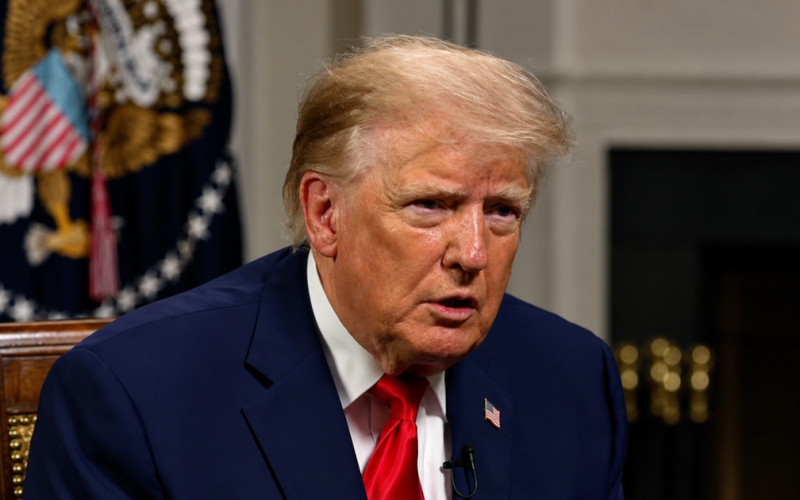
President Donald Trump has unexpectedly canceled a highly anticipated campaign rally in Kansas just days before the November 3 midterm elections, leaving some Republican insiders confused by the sudden change in plans.
The president had been scheduled to appear Saturday, October 31, at a campaign event supporting Kansas Sen. Roger Marshall (R), whose reelection race has become increasingly competitive.
Instead, Trump will participate virtually, according to sources who spoke with the Associated Press.
The White House confirmed that the president plans to hold more than 20 telephone rallies ahead of Election Day, signaling a shift toward remote campaigning during the final stretch of the election cycle.
The cancellation comes at a critical moment for Republicans, who are fighting to defend their congressional majorities as Democrats attempt to reclaim control of the House and Senate.
According to the Daily Mail, the unexpected decision surprised Republican insiders who had been requesting additional in-person appearances from the president.
Some GOP figures reportedly expressed confusion over the move, particularly given the importance of the Kansas Senate contest.
Trump previously visited Park City, Kansas, for a campaign rally on October 19, making his decision to cancel a second appearance less than two weeks later especially noticeable.
The White House’s initial announcement did not provide a detailed explanation for the scheduling change.
However, Trump subsequently addressed questions about the cancellation, insisting that his decision was unrelated to his health.
The president said he felt confident about the upcoming elections in Kansas and did not believe another in-person appearance was necessary.
During a confrontation with a reporter who repeatedly questioned whether his health or travel schedule played a role, Trump rejected the suggestion.
“You’ve been following me for two weeks. I feel perfect,” he said.
The exchange grew heated when Trump personally criticized the reporter.
“You are disgusting. Put yourself in shape. You look like hell,” the president declared.
Despite the confrontation, Trump maintained that his decision to skip Kansas was based on his assessment of the state’s political situation rather than any physical limitation.
Meanwhile, the president continued making appearances elsewhere.
On Thursday, October 29, Trump traveled to South Carolina to campaign for Republican Darline Graham, who is seeking the Senate seat previously held by her late brother, Lindsey Graham.
During the event in Rock Hill, Trump urged supporters to treat the midterm elections as a referendum on his presidency.
“I’m asking you to do me one favor — pretend that I’m on the ballot,” Trump told the crowd.
He argued that voters would effectively be deciding whether to preserve the accomplishments of his administration, even though his name would not appear on the ballot.
The president’s campaign activities come as Republicans confront an increasingly competitive national political environment.
According to figures cited in the Daily Mail’s election coverage, Democrats hold an 8.2-percentage-point advantage over Republicans in a national polling measure.
While such figures do not determine the outcome of individual congressional races, they illustrate the challenges Republicans face heading into the final days before voting concludes.
Kansas has become one of several Senate battlegrounds attracting increased attention.
Marshall, the Republican incumbent, is facing Democrat Adam Hamilton in a contest where recent polling has shown the candidates separated by narrow margins.
The president’s decision to replace an in-person appearance with a virtual event therefore represents a significant change in how he is supporting the Republican campaign.
It also raises questions about whether the administration believes remote events will allow Trump to reach more voters across multiple states in the limited time remaining.
The White House has not provided a detailed explanation of how the more than 20 planned tele-rallies will be distributed among competitive races.
For now, the Kansas cancellation stands out because of its timing.
With Election Day approaching, Republican candidates are attempting to maximize turnout and consolidate support in closely contested states.
Trump has made clear that he still intends to participate in the final campaign push, even if that means appearing remotely rather than traveling to every rally.
Whether that approach will affect turnout in Kansas or elsewhere remains unknown.
What is certain is that the president’s last-minute change has attracted attention inside Republican circles at a moment when both parties are focused on the final days of the midterm campaign.
