

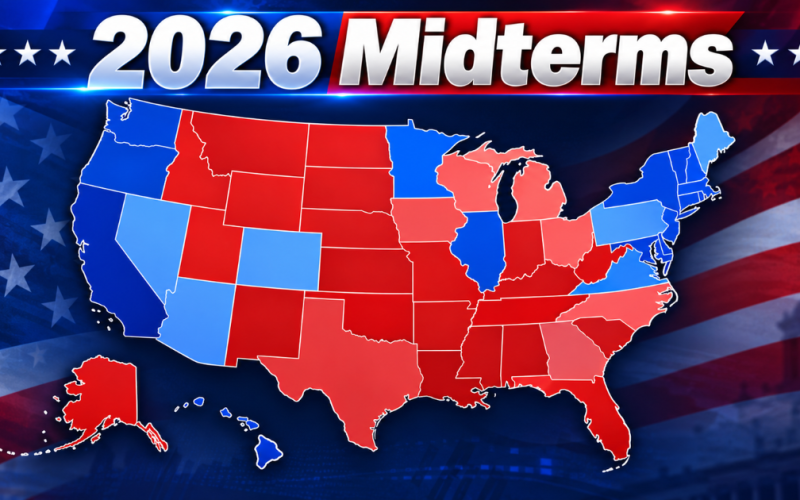
Republicans are gaining ground in several closely contested U.S. Senate races, with new polling showing GOP candidates holding narrow leads in key states just two weeks before the November 3 midterm elections.
Recent surveys in Texas, Kansas, Iowa, Michigan and Ohio have produced encouraging results for Republicans as the party fights to maintain its 53-47 Senate majority.
However, several races remain extremely competitive, with different polling firms reporting conflicting results and some advantages falling within the surveys’ margins of error.
One of the biggest developments came in Texas, where Republican Ken Paxton narrowly overtook Democrat James Talarico in an InsiderAdvantage survey conducted October 13-14.
The poll of 1,200 likely voters placed Paxton at 49% and Talarico at 48%, with a margin of error of 2.8 percentage points.
The result marked a shift from several previous surveys that had shown Talarico ahead.
Despite Paxton’s narrow advantage in the InsiderAdvantage poll, the RealClearPolitics average still placed Talarico ahead 48.5% to 46.3%.
A separate CBS News poll conducted through October 16 also showed Talarico leading 51% to 49%.
Kansas has emerged as another closely watched contest.
Republican Sen. Roger Marshall led Democratic challenger Adam Hamilton 48% to 47% in the latest InsiderAdvantage survey.
That result helped place Marshall slightly ahead in the RealClearPolitics polling average, 46% to 45.7%.
The narrow race has attracted attention because Kansas has not elected a Democrat to the U.S. Senate in more than 90 years.
President Donald Trump traveled to the state Monday to campaign for Marshall, seeking to bolster Republican support ahead of Election Day.
In Michigan, Republican Mike Rogers also received encouraging polling numbers.
A Tyson Group survey conducted October 6-8 found Rogers leading Democratic candidate Abdul El-Sayed 46% to 44%.
The poll surveyed 600 respondents and showed Rogers gaining three percentage points compared with the firm’s previous statewide survey conducted in late September.
Iowa Republicans have also received favorable results in the contest to replace retiring GOP Sen. Joni Ernst.
Republican Rep. Ashley Hinson led Democrat Josh Turek 48% to 45% in a co/efficient survey conducted October 19.
A Trafalgar Group poll conducted October 13-15 similarly placed Hinson ahead, 45.9% to 44.2%.
Earlier surveys from Emerson College and CNN also showed Hinson holding narrow advantages.
However, Marist and YouGov have produced results favoring Turek, underscoring the uncertainty surrounding the race.
Ohio has delivered similarly conflicting numbers.
Republican Sen. Jon Husted led former Democratic Sen. Sherrod Brown 49% to 47% in a Rasmussen Reports survey.
An ActiVote poll released October 18 showed an even narrower advantage for Husted, placing him at 50.2% compared with Brown’s 49.8%.
Yet other polling has favored the Democrat.
A Marist survey released Tuesday found Brown ahead by four percentage points, while the RealClearPolitics average placed him at 47.4% compared with Husted’s 44.6%.
Meanwhile, Republican Sen. Susan Collins faces a difficult contest in Maine against Democrat Troy Jackson.
Recent polls from InsiderAdvantage, Suffolk University and Rasmussen each showed Jackson leading 49% to 47%.
The RealClearPolitics average placed Jackson ahead by 1.6 percentage points, although an earlier co/efficient poll showed Collins holding a two-point advantage.
With Democrats seeking to regain control of the Senate, even small changes in voter preferences could significantly affect the chamber’s composition.
Fox News anchor Bret Baier highlighted the uncertainty Sunday, suggesting Republicans could emerge with a 52-48 majority if GOP candidates outperform polling averages by margins comparable to previous election cycles, per the Conservative Brief.
For now, the latest surveys show Republican candidates holding narrow leads in several important contests, while other polling continues to favor Democrats.
With Election Day approaching, both parties are concentrating on closely divided races that could determine control of the Senate for the next two years.
