

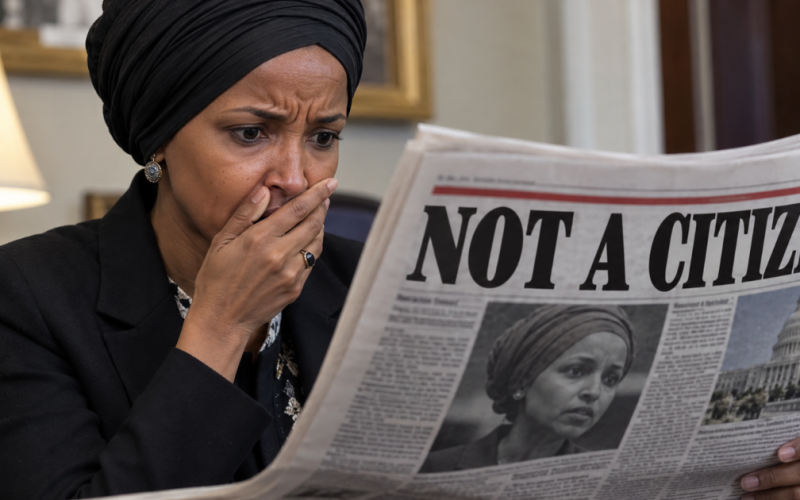
New allegations concerning Rep. Ilhan Omar’s (D-MN) citizenship history are drawing attention after purported letters from federal immigration agencies appeared to indicate that no naturalization records could be located for her late father.
The claims, circulating on social media, involve documents attributed to U.S. Citizenship and Immigration Services (USCIS) and the Department of Homeland Security (DHS).
According to the circulating account, the letters indicate that federal agencies could not locate records establishing that Omar’s father, Nur Omar Mohamed, became a naturalized American citizen.
The allegations could raise additional questions about Omar’s account of how she obtained American citizenship.
However, the authenticity and completeness of the purported letters have not been independently established, and the absence of records in a particular search does not necessarily prove that a naturalization never occurred.
Omar has maintained that she became an American citizen through her father’s naturalization in 2000, when she was 17 years old.
Under the citizenship rules relevant to that period, certain children of naturalized American citizens could obtain citizenship through their parents if they satisfied the applicable legal requirements.
That makes her father’s naturalization history an important part of the account Omar has provided concerning her own citizenship.
The latest claims suggest that inquiries to USCIS and DHS failed to produce records verifying the father’s naturalization.
However, the circulating account does not provide sufficient information to establish precisely what records were requested, which databases were searched or whether additional identifying information would be necessary to locate the relevant documents.
Those distinctions matter because federal immigration records can be maintained across different systems and agencies.
A response indicating that an agency could not locate a requested record is not necessarily equivalent to an official determination that the underlying event never happened.
Nevertheless, the allegations have prompted renewed questions about the documentation supporting Omar’s citizenship history.
The controversy also overlaps with separate claims concerning discrepancies in the congresswoman’s reported birth year.
Some previously discussed records identified Omar’s birth year as 1981, while others listed 1982.
The distinction has attracted attention because her age at the time of her father’s reported naturalization could be relevant to determining whether she qualified to acquire citizenship through him.
However, discrepancies in public biographical records do not independently establish that immigration documents were falsified.
The latest social media allegations raise a different question: whether the naturalization event on which Omar says her citizenship depended can be verified through official government records.
If questions about the documentation were formally raised in legal proceedings, determining the truth would require examination of authenticated records, applicable citizenship law and any additional evidence concerning the family’s immigration history.
Omar has repeatedly denied allegations that she obtained citizenship fraudulently.
The purported agency letters, as described in the circulating claims, do not establish that Omar knowingly provided false information or that her citizenship is invalid.
They also do not demonstrate that federal authorities have made a formal determination concerning her citizenship status.
For now, the central question remains whether the documents accurately represent the results of comprehensive searches of her father’s naturalization history.
Until the letters are authenticated and their scope is established, claims that no record of his naturalization exists remain unverified.
The controversy underscores the importance of the underlying immigration documentation, but it does not, by itself, establish wrongdoing by Omar or her family.
