

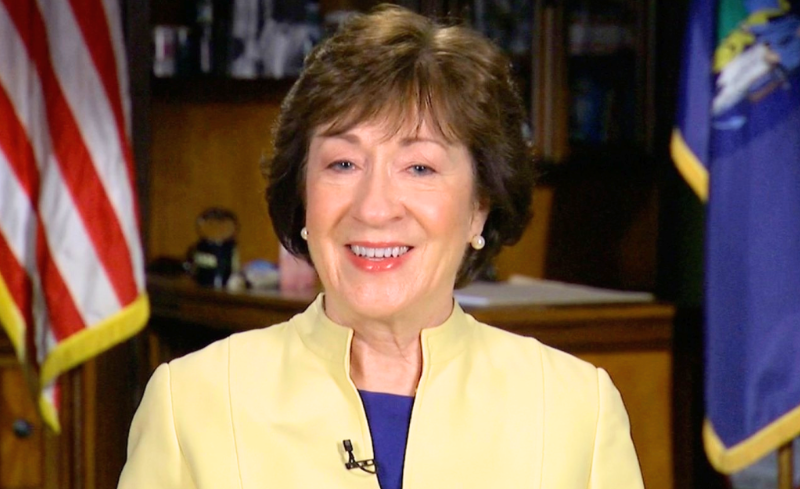
PORTLAND, Maine – Sen. Susan Collins spent her one direct question to Democratic challenger Troy Jackson on his track record in the Maine Legislature during a Tuesday night debate in Portland.
“In your more than 20 years in the legislature, more than one-third of your bills were unanimously rejected in committee.
You couldn’t even find one Democrat on the committee to support a third of your bills,” the Republican incumbent began.
She then pressed the point.
“If you can’t find one person in your own party to vote for your bills when you were the Senate president in Maine, how do you think you’re going to get things done in a closely divided Senate as the most junior senator?” Collins asked.
Jackson served as Maine Senate president from 2018 to 2024. He answered that multiple lawmakers often put forward the same bill, and he said he was a team player who let other bills go forward.
He then turned to Collins’ Senate tenure. Jackson said he does not see what legislation she has passed that has helped the people of Maine.
Earlier in the night, the two candidates clashed over health care money. Jackson told the audience that Collins had raised the issue of low Medicaid reimbursement rates.
“Sen. Collins just brought up how [Medicaid] reimbursement rates are not high. She’s been in Congress for 30 years. She touts how she’s chair of appropriations. Yeah, it would be great if she actually worked on that and got that done, because we’re not getting enough reimbursement,” Jackson said.
Collins responded within moments and pointed to Augusta.
“Medicaid rates are set by the state. They are not set by the federal government. Medicare rates are set by the federal government.
So it is Augusta [Maine’s state capital] that is responsible for the inadequate reimbursements under the Medicaid program,” she said.
The Centers for Medicare and Medicaid Services addresses the subject on its website. The agency publishes a page that compares reimbursement rates and explains how states handle them.
“The Medical Assistance (MA) rate is a state’s standard reimbursement for Medicaid-covered services. Each state sets how it will reimburse Medicaid recipients. For example, some states reimburse for each service provided during an encounter (a face-to-face interaction between the patient and the healthcare provider), rather than setting a flat fee for each encounter,” the website says.
The same page describes the limits that apply.
“The amount of money Medicaid reimburses depends on individual state policies and other factors. However, reimbursement rates must fall between the federally established minimum and maximum payment limits,” it says.
Figures from the Kaiser Family Foundation show how the bills get divided in Maine. The federal government covers 67 percent of the state’s Medicaid expenses, and the state covers the other 33 percent.
Jackson also pointed to two of Collins’ votes that he called harmful. He named the “Big Beautiful Bill” and the Iran war.
On the first, Collins voted against final passage of the “Big Beautiful Bill.” She said she would support the measure only if $50 billion for rural hospitals was added to it.
Collins did vote in favor of a procedural motion on the bill. That vote allowed the Senate to take up the legislation on the floor.
The law eliminates federal taxes on tips, overtime and Social Security. It also raises the standard deduction and increases the child tax credit to $2,200 per child.
Supporters of the measure say those changes let Mainers keep more of what they earn.
The Iran war votes unfolded over two months. In March, Collins voted against a War Powers Resolution that would have halted the military engagement.
The following month, she sided with Democrats in an effort to force President Donald Trump to end the conflict.
Medicaid, tax policy and the Iran conflict filled much of the Portland debate. Collins used her time to defend her votes and question Jackson’s legislative record, while Jackson used his to challenge hers.
