

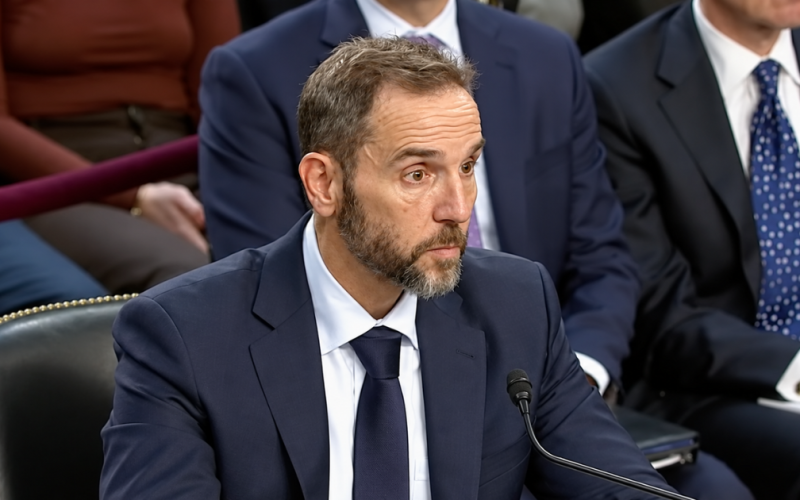
Newly released documents show that former Special Counsel Jack Smith’s investigation obtained financial information connected to thousands of people who donated to President Donald Trump and affiliated political groups.
The records were released by Senate Judiciary Committee Chairman Chuck Grassley as part of his ongoing review of the FBI investigation known as “Arctic Frost.”
According to the documents cited by Grassley, investigators obtained at least 4,782 personal checks from donors across all 50 states.
Many of the contributions were small-dollar donations, with some reportedly worth as little as $1.
The checks covered a broad period stretching from September 2019 through August 2023.
The documents have fueled new questions about how much donor information federal investigators collected while examining efforts surrounding the 2020 election and the transfer of presidential power.
Grassley confronted Smith directly about the issue during testimony before the Senate Judiciary Committee.
“Did you obtain possession of donor data, to include financial information, yes or no?” Grassley asked.
Smith initially responded by describing the purpose of his investigation.
“Our investigation was focused on investigating matters under my mandate including whether any person or entity violated the law with attempts to block the peaceful transfers of power,” Smith said.
Grassley then repeated the question.
“Did your special counsel operation obtain possession of donor data, to include financial information, yes or no?” he asked.
Smith acknowledged that investigators had obtained financial records.
“Yes, we acquired financial information,” Smith said.
He added that he could not recall every subpoena issued by his team but defended the collection as part of a criminal investigation.
“It was to conduct a criminal investigation into one of the most serious crimes in our nation’s history,” Smith said. “I had a duty to collect facts.”
Grassley immediately pointed to the scope of the material.
“The list includes checks from constituents in every state of every single member of this committee, both Republicans and Democrats,” the Iowa Republican said.
Grassley argued that members of both parties should be concerned about the privacy implications for their constituents.
According to the senator, some of the checks contained sensitive financial and personal information.
That information could include home addresses, bank account numbers, routing numbers and signatures.
Grassley said the Justice Department and FBI may still possess those records.
The senator also criticized Smith for not discussing the donor information in his publicly released report.
The controversy is part of Grassley’s broader scrutiny of Arctic Frost, an FBI investigation launched in 2022 and later associated with Smith’s special counsel probe.
Grassley has accused investigators of casting an excessively wide net while examining Trump and individuals or organizations connected to him.
Documents previously highlighted by the committee reportedly included toll records associated with 16 members of Congress.
Investigators also obtained information connected to hundreds of Republican organizations and individuals, according to the Western Journal.
Grassley has further pointed to records involving dozens of Trump White House phones.
Those records reportedly included communications involving members of Congress and numerous media organizations.
Grassley characterized the scope as evidence of federal overreach and accused the Biden administration of using law-enforcement authorities against Republicans.
That characterization reflects Grassley’s assessment of the investigation.
Smith, by contrast, defended his investigative decisions as necessary efforts to gather evidence relating to possible criminal conduct.
The source also says Grassley accused the FBI of applying a different standard in earlier investigations involving Hillary Clinton and the Clinton Foundation.
Grassley argued that agents did not pursue donor-related questions in those matters as aggressively as investigators later did during Arctic Frost.
The newly released material does not establish that ordinary Trump donors were suspected of crimes merely because they contributed money.
It does, however, show that financial information associated with thousands of donor checks became part of the investigative material obtained by Smith’s team.
That distinction is now at the center of the dispute.
Grassley is questioning why such a large amount of donor information was collected and whether the government appropriately protected Americans whose financial details were swept into the investigation.
Smith maintains that his team had an obligation to obtain relevant evidence while investigating potential crimes.
The disclosure is likely to keep scrutiny on Arctic Frost as congressional investigators continue reviewing how far the federal probe extended and what information remains in government possession.
