

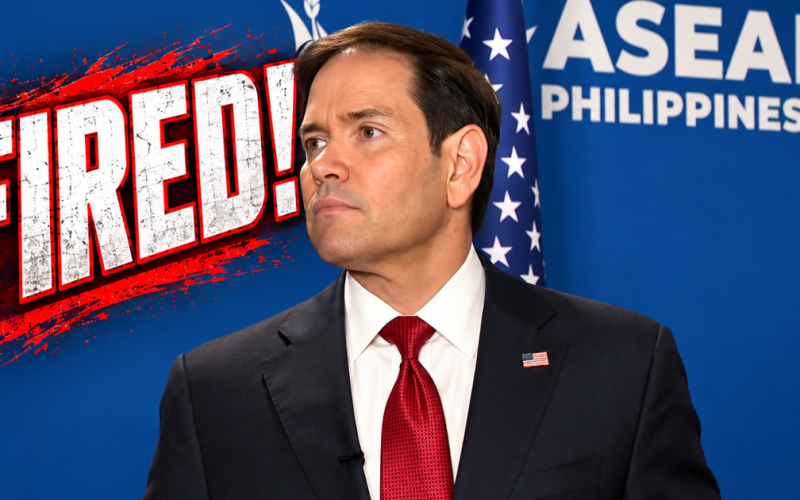
Secretary of State Marco Rubio fired a U.S. Foreign Service officer after the diplomat acknowledged concealing a romantic relationship with a Chinese national whose father had ties to the Chinese Communist Party, according to State Department statements and reporting on the case.
The officer was identified in undercover footage as Daniel Choi. In the recording, Choi acknowledged that State Department security rules required him to disclose information about the relationship but said he chose not to do so.
“I defied my government for love,” Choi said in the video released by O’Keefe Media Group.
Choi also described the woman’s father as an education official in China and “straight-up Communist Party.” Asked whether the woman herself could have been involved in espionage, Choi said she “could have been a spy,” while also making clear that he did not know whether she actually was.
The video did not establish that the woman was a Chinese intelligence operative, and the State Department has not publicly presented evidence that she engaged in espionage.
The firing itself occurred in October 2025, meaning the Sept. 19, 2026 report circulating the story is revisiting an action taken nearly a year earlier. Contemporary reports from October 2025 confirmed that the State Department dismissed the officer after presidential review and approval.
According to the State Department, Rubio recommended the officer’s removal after reviewing the matter, and the White House subsequently approved the action. The department said the officer had admitted concealing a relationship he was obligated to report.
State Department Principal Deputy Spokesperson Tommy Pigott said at the time that the department would maintain a “zero-tolerance policy” toward employees whose conduct undermines national security.
The department said the termination was carried out under authority reinforced by President Donald Trump’s Executive Order 14211, signed Feb. 12, 2025.
The order, titled “One Voice for America’s Foreign Relations,” states that federal employees responsible for implementing U.S. foreign policy serve under presidential authority and that failure to faithfully implement that policy may result in professional discipline, including separation from government service. It also gives the secretary of state authority, consistent with applicable law, to reform personnel procedures involving recruiting, evaluation and retention.
The State Department said Choi’s dismissal was the first known case in which the department relied on the executive order as the basis for terminating a Foreign Service officer.
Foreign Service personnel holding security clearances are subject to reporting requirements involving certain close or continuing contacts with foreign nationals. Those requirements are designed to allow security officials to evaluate possible risks involving foreign influence, coercion or intelligence recruitment, per the Conservative Brief.
In the undercover footage, Choi acknowledged knowing that he was expected to disclose information concerning the relationship.
“I was supposed to, whatever, sort of report what I knew about her,” Choi said, while describing the requirement as unfair.
The State Department characterized the dismissal as both a personnel and national-security matter. The publicly available reporting does not establish that Choi’s former partner committed espionage or that Choi transmitted classified information to her.
