

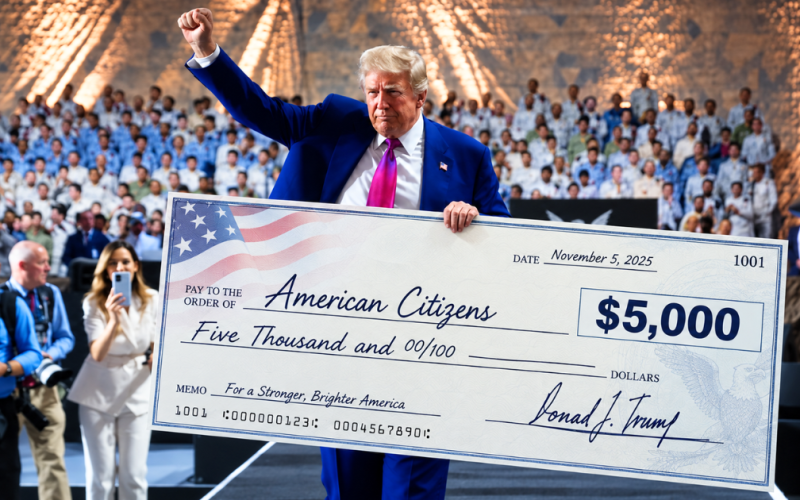
President Donald Trump has pledged to send $5,000 payments to American adults if Republicans retain control of Congress in the November midterm elections, unveiling what he called a “Trump Dividend” during the GOP’s convention in Dallas.
“If the Republicans win, you win with us and you get $5,000,” Trump said during the Sept. 9 gathering. “It will be called the Trump Dividend.”
The proposal would require congressional approval and could cost more than $1 trillion, depending on who ultimately qualified for the payments. House Speaker Mike Johnson later confirmed that Congress would have to authorize the plan before any checks could be distributed.
Trump compared the proposed payments to dividends that corporations distribute to shareholders, pointing to what he described as strong U.S. economic performance.
The White House initially provided few details about how the program would operate, including whether all adults would qualify or where the government would obtain the necessary funds.
Vice President J.D. Vance subsequently suggested wealthy Americans might be excluded and said tariff revenue could help finance the payments.
The proposal comes as federal finances remain under pressure. Treasury estimated in August that the government would need to borrow $739 billion in privately held marketable debt during the July-through-September quarter and another $628 billion during the final three months of 2026.
Trump has continued defending the idea since announcing it, saying days later that the payments would be “easy” to accommodate in the federal budget because of government revenue. Reuters reported that some lawmakers from both parties have questioned the proposal’s cost and potential economic effects.
The plan is also significantly larger than a $2,000 dividend Trump floated earlier in 2026.
Sen. Bernie Moreno, R-Ohio, said following Trump’s announcement that he intended to prepare legislation that could be considered after the Nov. 3 election.
“I will get a bill ready so that we can get the Trump Dividend passed immediately after the November 3rd election,” Moreno wrote on X.
Whether tying the proposal to the election raises legal concerns has also drawn attention.
New Mexico attorney John Day told The Associated Press that the campaign promise itself would not amount to buying votes because the proposed money would be distributed based on eligibility rules rather than how an individual voted — or whether that person voted at all, per AP.
“This is a campaign promise,” Day said. “It’s not a payment to individuals to try to get them to vote in a particular way.”
Republicans have not uniformly embraced the proposal. More recent AP reporting found that many GOP candidates have largely avoided making the $5,000 dividend a centerpiece of their own campaigns, while some Republicans have raised questions about its price tag and inflationary effects.
The proposal comes as Republicans campaign to maintain their congressional majorities during Trump’s second term.
For now, no $5,000 payment has been authorized. Any “Trump Dividend” would still require legislation to move through Congress before money could be distributed to Americans.
