

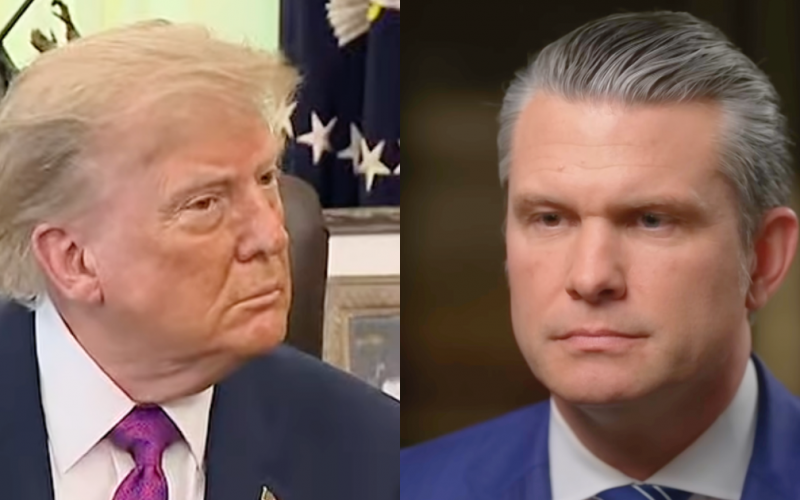
President Donald Trump is reportedly elevating Treasury Secretary Scott Bessent’s role in the ongoing conflict with Iran as frustration with Secretary of War Pete Hegseth has surfaced inside the administration.
The shift comes after Trump reportedly confronted Hegseth during a Camp David retreat earlier this month over shortages of critical US military munitions. According to the Daily Mail, Trump was confused by the shortage because he believed the problem had already been resolved.
The Daily Mail published its report Saturday, citing several administration and Republican sources familiar with the president’s thinking.
“One is a sledge-hammer and the other is a scalpel,” one source told the outlet while contrasting Hegseth’s military approach with Bessent’s focus on economic pressure.
Hegseth has reportedly favored the continued use of overwhelming military force against Iran, while Bessent has emerged as a leading voice behind a strategy centered on sanctions and economic pressure.
The reported change comes nearly six months after the war with Iran began, with the administration looking for a path forward that does not depend primarily on continued strikes.
Trump’s frustration with Hegseth reportedly boiled over during the Camp David meeting when the president learned how depleted some US missile stockpiles had become.
A source told the Daily Mail that Hegseth is among the advisers who “tells Trump what he wants to hear,” an accusation that echoes concerns reportedly expressed by Republicans on Capitol Hill.
One Republican member of the House Armed Services Committee offered an even harsher assessment last month.
“Hegseth is afraid of Trump and won’t be as honest as he should about the war for fear of losing his job,” the lawmaker told the outlet.
Bessent, meanwhile, has reportedly been gaining influence during high-level meetings involving the conflict.
When Trump gathers advisers for Situation Room briefings, Hegseth, Joint Chiefs Chairman Gen. Dan Caine, Vice President JD Vance and Secretary of State Marco Rubio are among the officials who provide the president with assessments.
More recently, however, Trump has increasingly elevated Bessent during those discussions, according to the Daily Mail.
Bessent announced “Operation Economic Outcast” at the Treasury Department on Monday, outlining an effort to use sanctions against Iran and its trading partners to push Tehran toward negotiations.
“The environment changed,” an administration insider said, adding that officials have realized they “can’t bludgeon them anymore.”
The strategic shift has coincided with reports that US stocks of air-defense missiles and other critical munitions have been dwindling.
The US has also gone roughly a month without publicly confirming a strike on Iran. The last confirmed attack occurred July 29, when US Central Command announced a “heavy wave of strikes” against dozens of targets.
Bessent’s role in the conflict is not entirely new. He sits on the National Security Council and has already used Treasury Department sanctions to target Iranian oil revenue and other sources of income, per the Daily Mail.
One administration source described Bessent as increasingly trusted by Trump.
“It’s not just on Iran, his stock is increasing,” the source said. “He’s just more and more involved in things.”
His growing profile could also prove significant as the administration approaches the midterm elections, when economic issues are expected to become increasingly important.
“Bessent is just the person they roll out,” a source close to Trump told the Daily Mail. “As the midterms come up it’s economy, economy, economy.”
Hegseth’s allies, however, are pushing back against suggestions that Bessent’s expanded role amounts to a demotion for the war secretary.
A senior Department of War official told the outlet that there are limits to the amount of military action Congress and the public will accept and argued that Bessent’s economic measures complement the bombing campaign.
Hegseth himself publicly backed the economic strategy Monday, saying economic pressure currently hurts Iran the most while leaving additional military action on the table if necessary.
“If we need to use kinetic strikes, we’ll use them,” Hegseth said.
The White House similarly rejected the idea that Hegseth is being pushed aside entirely.
“Secretary Bessent has been involved throughout this entire conflict, and Secretary Hegseth will continue to be heavily involved,” a White House official said.
Still, the reported Camp David confrontation and Bessent’s expanding influence point to a change in how Trump is approaching the Iran conflict, with economic pressure taking a larger role as the administration weighs its next move.
