

Buried artifacts pulled from dry Middle Eastern soil are doing something centuries of sermons never fully achieved: forcing critics to reckon with the historical footprint of Scripture.
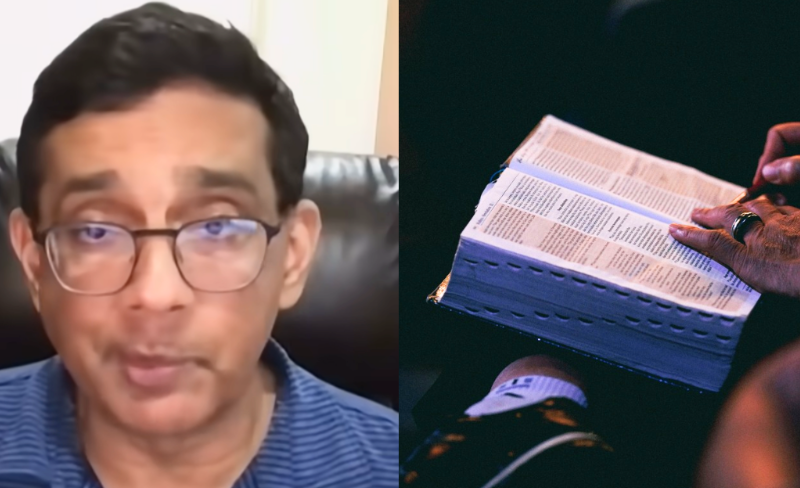
That’s the claim at the heart of a new book by conservative author and filmmaker Dinesh D’Souza, whose three-year investigation into biblical archaeology grew out of a single trip to Israel.
Speaking with Fox News Digital, D’Souza explained what pulled him into the subject in the first place. The field, he said, “stunningly supports the historicity of the Bible.”
That fascination became a book. “The Stones Cry Out” hits shelves Oct. 13, capping off a research effort D’Souza launched back in 2022.
Rather than focusing narrowly on one era, the book ranges across both the Old and New Testaments, tracing physical evidence tied to real people, real places and real events described in the biblical text.
Some of the strongest evidence, D’Souza argued, doesn’t come from marquee biblical figures at all. Instead, it’s the minor characters — men mentioned in only a handful of verses — whose names have turned up etched into stone or bone thousands of years later.
Not everyone finds this persuasive. D’Souza said he’s well aware that skeptics dismiss such findings as coincidence or embellishment. He isn’t swayed by the pushback.
“I think the skeptics generally are sort of armchair critics,” he said. “The problem for them is that archaeology is digging out of the ground artifacts that are a decisive refutation of the things that they say.”
Take Pontius Pilate. For generations, doubt swirled around the biblical portrait of the Roman governor who sentenced Jesus to crucifixion — until a 1961 excavation changed the equation entirely.
Archaeologists unearthed what’s now known as the Pilate Stone, an inscribed artifact naming Pilate directly and identifying him as “prefect of Judea.” Today, it sits on permanent exhibit at the Israel Museum in Jerusalem.
D’Souza didn’t hold back his reaction to the find.
“Boom. Not only does it confirm the existence of Pilate, but the Bible writers had his title exactly correct,” he said. He noted a wrinkle worth understanding: Pilate’s title was later updated to procurator, but at the actual time Jesus lived, the title the Bible assigns him was accurate. “Later, the title was evidently changed to procurator — but in Jesus’ own time, Pontius Pilate had the title that the Bible ascribes to him,” he added.
A second case takes readers to Jordan.
The Old Testament recounts how the Israelites, marching toward the Promised Land, passed through Moabite territory — prompting the Moabite king to hire a diviner named Balaam to place a curse on them.
In 1967, diggers working a site called Deir ‘Alla, located in what’s now Jordan, found a plaster inscription bearing the phrase “Balaam, son of Beor.” The name and family line match the diviner from Scripture precisely.
D’Souza described the skeptical reflex to such a find, then the reversal that followed.
“So skeptics, no surprise, go, ‘This stuff is clearly made up,’” he said. “Well, fast-forward. … This is a guy who has just a few sentences in the Bible, and yet, thanks to this plaster inscription found in Jordan, he jumps out of the pages of the Bible and into the pages of history via the pathway of archaeology.”
Perhaps the most dramatic case D’Souza raised involves Caiaphas, the high priest who oversaw Jesus’ trial. D’Souza didn’t mince words about the man’s role, calling him “one of the villains of the Bible.”
“He presides over the trial of Jesus. He orchestrates the crucifixion,” D’Souza said. For centuries, though, Caiaphas existed almost entirely as a scriptural figure — absent from the broader historical record. “Yet for many, many centuries, Caiaphas had a kind of shady existence. He was mainly in the Bible, but not really outside the Bible,” D’Souza said.
That absence ended when archaeologists digging in Jerusalem uncovered an ossuary — a stone box used to hold bones — inscribed with the name “Yehoseph bar Caiapha.”
D’Souza recounted what came next. “They look inside the box. It’s the bones of a 60-year-old man. They date it. It goes to the first century A.D. It’s Caiaphas,” he said.
For D’Souza, the discovery carries weight beyond a simple name on stone.
“And the amazing thing is, we not only have an inscription or reference to him, we have his actual bones. … Archaeology provides this kind of stunning corroboration for the people, the places and the events in the Bible,” he said.
D’Souza framed his book’s larger purpose as a bridge — connecting dense academic scholarship with everyday readers who may never read a peer-reviewed excavation report. “It’s a complex field, but it’s very rewarding,” he said.
His research also led him to a broader appeal: he’s urging fellow Christians to make the trip to Israel themselves. He called the nation “our spiritual homeland,” setting it apart from surrounding regions of the Levant.
“All of the Old Testament and Jesus’ own ministry takes place in the [land] of Israel,” D’Souza said, adding that walking the actual terrain sharpens a reader’s grasp of biblical language and imagery.
He pointed to the Pool of Siloam as a prime example — a site where visitors physically retrace steps once taken by Jesus. D’Souza called standing in such locations an “exhilarating feeling.”
For readers who can’t book a flight to Jerusalem, D’Souza offered a substitute. “If you can’t make it, ‘The Stones Cry Out’ is the next best thing,” he said.
