

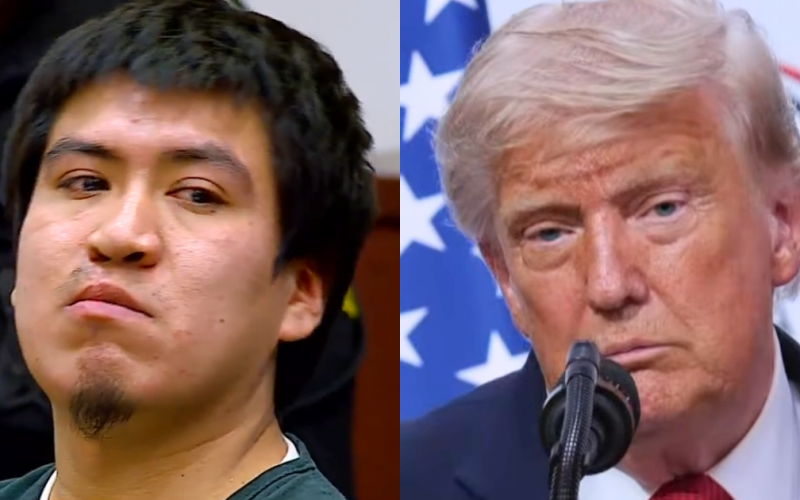
A Mexican national serving a decades-long prison sentence for the murder of a Michigan woman has filed a federal lawsuit against President Donald Trump and a White House official, alleging his case was featured prominently in Trump’s campaign messaging on immigration.
Brandon Ortiz-Vite, 27, is seeking $75 million, a public apology, and U.S. citizenship.
Ortiz-Vite is serving a sentence of 39 to 102 years in prison after pleading guilty to second-degree murder and other charges in connection with the March 2024 killing of Ruby Garcia in Grand Rapids, Michigan.
Authorities said Garcia was found dead near a Grand Rapids roadway after being shot during an altercation with Ortiz-Vite, who had been in a relationship with her.
Ortiz-Vite turned himself in two days after the killing and later pleaded guilty.
The lawsuit, filed handwritten by Ortiz-Vite in the U.S. District Court for the Western District of Michigan, names Trump and White House Principal Deputy Press Secretary Steven Cheung as defendants.
Ortiz-Vite alleges that Trump’s public comments and use of his image during campaign messaging caused humiliation and damaged his reputation.
The complaint does not identify specific legal violations but argues that his case was used for political purposes, according to Fox News.
Trump highlighted Ortiz-Vite’s case during a 2024 visit to Grand Rapids, where immigration enforcement was a major focus of his remarks.
During his 2024 campaign messaging on border security, Trump pointed to Ortiz-Vite’s case and included his image in advertisements highlighting crimes committed by individuals who entered the country illegally.
In his filing, Ortiz-Vite said the national attention surrounding the case affected him while he was incarcerated.
In the filing, Ortiz-Vite argued that the publicity surrounding his case overshadowed his identity and said he faced ridicule behind bars because of the attention the case received.
Ortiz-Vite also said the publicity caused distress and described becoming a nationally recognized figure because of the case.
Ortiz-Vite previously entered the United States illegally and was protected under the Deferred Action for Childhood Arrivals program until his status expired in May 2019, according to MLive.
He was deported in 2020 following an arrest for driving while intoxicated but later returned to the United States. Authorities have said he is expected to be deported after completing his prison sentence.
Matthew Borgula, a Grand Rapids criminal defense attorney and former federal prosecutor, said he does not expect the lawsuit to move forward.
He cited the requirement that courts screen prisoner lawsuits before they proceed and said the complaint would likely fail for multiple reasons, including questions surrounding presidential immunity and the lack of an alleged constitutional violation.
Borgula said Trump’s statements about Ortiz-Vite’s case were substantially accurate and argued that public criticism from a politician does not create a legal basis for damages.
He also said that because Ortiz-Vite pleaded guilty to second-degree murder, a lawsuit claiming his conviction was unfair would not provide a path to financial compensation.
Ortiz-Vite wrote in the lawsuit that he accepts responsibility for Garcia’s death, stating that he turned himself in and confessed after the killing.
He is requesting financial damages, a public apology, and “naturalization to this beautiful country” as part of his requested relief.
WATCH:
