

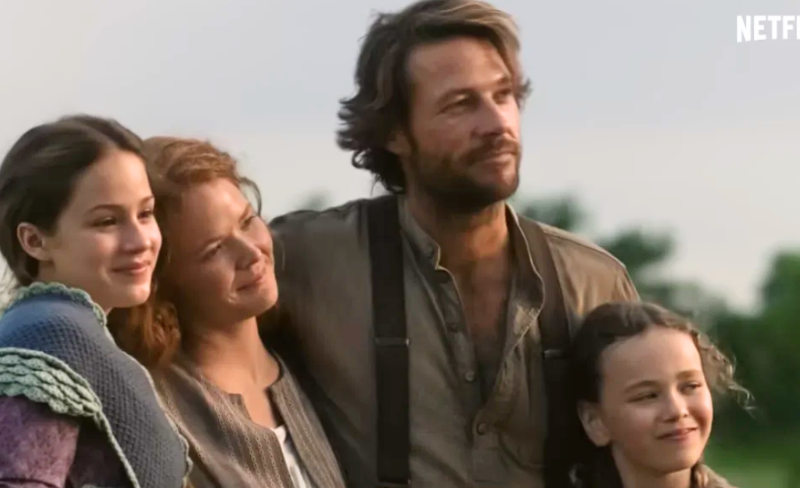
A new streaming adaptation of one of America’s most cherished literary series is generating discussion for the philosophy driving its production.
Netflix debuted its reimagined “Little House on the Prairie” on July 9, delivering eight episodes built on a foundation markedly different from prior screen versions of Laura Ingalls Wilder’s work.
At the center of the conversation is showrunner Rebecca Sonnenshine, who has been candid about the creative philosophy shaping the project.
In remarks given to Deadline, Sonnenshine outlined her view that decades of Western entertainment have misrepresented how frontier life actually unfolded.
“I think a lot of our pop culture portrays the West as men riding around with guns and solving problems with violence and posturing, but that is just not how it was settled,” Sonnenshine said.
Rather than gunslinging and combat, Sonnenshine argued that a different force built frontier communities from the ground up.
“This is not how communities were formed. It was women, they were the backbone of the country, the formation of the country, and so I really wanted to explore that,” Sonnenshine said.
Sonnenshine’s remarks reflect a broader production strategy: her team reportedly worked to strip out storytelling conventions she associates with male-centered narratives.
She summarized that effort as resisting “tropes of sort of masculinity” commonly found in Western film and television.
Longtime fans of the franchise will recall the version most familiar to American households — the NBC series starring Michael Landon and Melissa Gilbert, which ran from 1974 through 1983 and became a staple of network television.
This new Netflix production, however, does not remake that 1970s and 1980s broadcast series. Instead, it returns to Wilder’s original novels as its primary source material.
Sonnenshine singled out two characters, Caroline and White Sun, as vehicles for the show’s emphasis on female relationships and influence.
“We really are trying to do a show that does not fall back on tropes of sort of masculinity, and we’re leaning into how women shaped our lives, definitely through Caroline and through White Sun, who are both women who are in interesting marriages of equality,” Sonnenshine said.
Sonnenshine has also pointed to the source books themselves as justification for the show’s direction, noting they contain relatively little violence compared with typical Western fare.
That characteristic of Wilder’s writing, according to Sonnenshine, allowed the writing staff to prioritize storylines centered on domestic routines, town life and the daily labor of women rather than armed conflict.
The approach stands in contrast to a long tradition of Western storytelling, where standoffs, lawmen and armed confrontation have frequently driven the plot.
Since the season’s release, Sonnenshine’s public comments have drawn renewed attention to how the adaptation frames itself against earlier, more action-oriented portrayals of frontier America.
The series now sits within Netflix’s expanding catalog of literary adaptations, entering a genre historically dominated by rugged male leads and shootout-driven plots.
Viewers now have the ability to stream the new season and measure its tone directly against the Michael Landon-era series that shaped perceptions of the Ingalls family for an entire generation.
How audiences respond to this reworked vision of the American frontier will become clearer as viewership numbers and reactions continue to roll in.
