

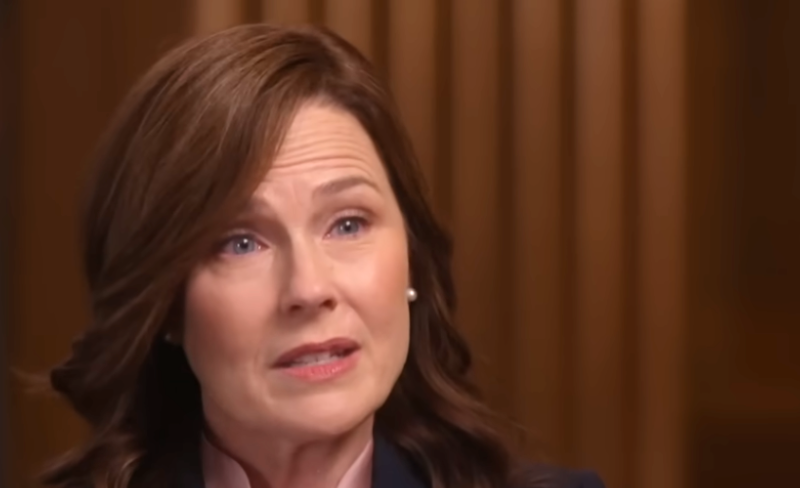
Law enforcement descended on the Fairfax County, Virginia residence of Supreme Court Justice Amy Coney Barrett late Wednesday night, May 27, 2026, after an anonymous caller triggered a police response with a fabricated emergency.
The call arrived on the police non-emergency line just after 9 p.m., placed by an individual who identified themselves as Barrett’s neighbor.
The caller alleged that gunshots had been fired at the residence — a claim that set off an immediate law enforcement response.
Dispatch audio captured the moment officers were warned the situation may not be what it seemed.
“Units responding to suspicious noise, be advised, we have not been able to get an answer on callback to the complainant’s phone number. Unknown if it’s going to be a swatting situation,” the dispatcher told responding units.
The dispatcher also flagged the location as belonging to a “high-priority resident of the county,” one who maintained 24-hour security coverage at the address.
Officers made contact with that security detail before proceeding further.
“Just made contact with security that’s on scene. They should be outside in an Explorer. He said he hasn’t heard anything. We’re just going to meet up with him first, just to go over anything,” a responding officer reported back.
The Fairfax County Police Department confirmed in a statement: “Officers immediately coordinated with Supreme Court Police personnel assigned to the residence and quickly determined that the report was fictitious. No additional police resources were utilized.”
Barrett shares the Virginia home with her husband and children.
The following morning, Barrett took her seat on the bench as scheduled, read summaries of two opinions she had authored, and offered no public remarks about the previous night’s events.
As of the time of reporting, no arrests had been made and the identity of the caller remained unknown.
Utah Republican Senator Mike Lee did not mince words in his response, writing on X: “Swatting is an attempt to get an innocent person killed—in this case, a sitting Supreme Court Justice. The proper response will be putting the offender in prison for many, many years.”
Wednesday’s incident did not arrive in a vacuum. Barrett’s home has drawn unwanted attention for years.
Following the 2022 leak of the Dobbs v. Jackson Women’s Health Organization draft opinion — the decision that ultimately overturned Roe v. Wade — the activist group Ruth Sent Us published the residential addresses of multiple Supreme Court justices, Barrett’s among them.
Protesters appeared outside her home the day after a separate and far more serious threat unfolded nearby.
A woman later pleaded guilty to attempting to assassinate Justice Brett Kavanaugh and was sentenced to eight years in prison.
Authorities found her outside Kavanaugh’s Maryland home carrying a handgun, a knife, pepper spray, and burglary tools.
During that period of unrest, then-White House Press Secretary Jen Psaki addressed the demonstrations at justices’ homes directly.
“So, I know that there’s an outrage right now, I guess, about protests that have been peaceful to date, and we certainly continue to encourage that outside of judges’ homes and that’s the President’s position,” Psaki told reporters.
The threats against Barrett’s family have not been limited to her own doorstep. In March 2025, her sister Amanda Coney Williams received a bomb threat at her Charleston, South Carolina home.
An email to the Charleston County Sheriff’s Office claimed a pipe bomb had been placed in her mailbox, though a search turned up nothing.
Barrett has also spoken publicly about her family receiving pizzas they never ordered — a growing intimidation tactic that federal investigators have been examining after judges nationwide reported the same pattern.
Separately, an Alaska man who threatened to torture and assassinate justices and their families struck a plea deal with prosecutors last month.
Around-the-clock security for Supreme Court justices has been in place since at least 2022, put there in direct response to the wave of threats and protests that followed the Dobbs leak.
