

Federal immigration officials say investigators have uncovered more than 10,000 potential fraud cases tied to a foreign student work authorization program, intensifying scrutiny of what critics describe as an open-borders enforcement failure within the U.S. visa system.
The findings involve the Optional Practical Training (OPT) program for F-1 visa holders, which allows international graduates to remain in the United States after completing their degrees and work in fields related to their studies.
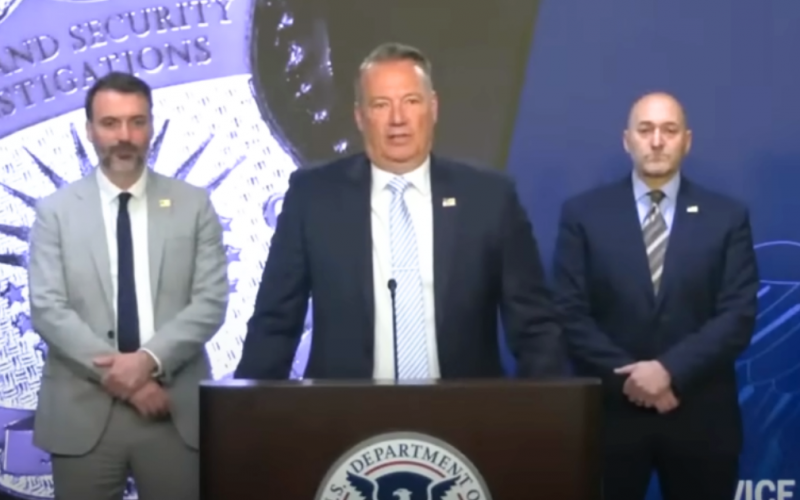
Acting Immigration and Customs Enforcement (ICE) Director Todd Lyons said during a briefing alongside Homeland Security Investigations (HSI) officials that the OPT system is under heightened review amid what he described as widespread abuse involving both employers and foreign nationals.
He said investigators have identified suspected fraud involving job placements, shell companies, and falsified or inconsistent employment records used to maintain visa status, NRI Pulse reported.
Officials described the OPT program as originally intended to provide temporary, degree-related work experience but said it has increasingly come under strain as participation expanded.
Lyons characterized the system as vulnerable to exploitation, saying enforcement teams are examining whether violations reflect isolated cases or a broader pattern of abuse.
According to ICE officials, initial investigative efforts have focused on a group of high-volume employers participating in the program.
The agency said the more than 10,000 potential fraud cases identified so far represent preliminary findings and may reflect only a portion of a broader review.
Investigators reported patterns involving companies that allegedly sponsor large numbers of foreign students while showing limited evidence of legitimate business operations.
In multiple cases, listed worksites were found to be residential addresses, vacant office spaces, or postal box locations used as business headquarters.
HSI teams conducting fieldwork in Texas identified what officials described as clusters of interconnected companies operating from shared locations.
These entities often displayed similar websites, overlapping staffing structures, and nearly identical job postings while denying formal business relationships with one another.
“This is only the tip of the iceberg,” Lyons said. “Over the past year, we’ve dramatically expanded our oversight of OPT and can report that we’ve found fraud nationwide.”
Across multiple states—including Texas, Georgia, New York, New Jersey, Virginia, Florida, Illinois, and North Carolina—investigators reported additional inconsistencies.
These included employers unable to verify basic employment records for large numbers of sponsored workers, as well as discrepancies between company-reported staffing levels and federal visa records, according to The Daily Wire.
In some cases, officials said employers reported only a handful of workers while government data showed hundreds of students listing those companies as sponsors.
Investigators also noted instances where company representatives could not answer fundamental questions about operations or directed inquiries to overseas contacts, raising concerns about whether key business functions were being handled outside the United States.
ICE officials said the findings are being evaluated as part of a broader compliance review of the OPT system, with investigators examining whether questionable employer structures and reporting inconsistencies point to coordinated abuse.
The agency said enforcement actions could follow, depending on the outcome of ongoing case reviews.
The OPT program, created to provide temporary work experience for foreign graduates in science, technology, engineering, and mathematics fields, has been expanded over time to extend work eligibility beyond graduation.
Officials said the program was intended as a bridge between academic study and professional employment but is now facing renewed scrutiny over oversight gaps.
ICE officials said the investigation remains active and that additional findings are expected as reviews continue.
Individuals or employers found to have violated program rules could face immigration consequences, financial penalties, or criminal referral depending on the evidence developed during enforcement proceedings.
WATCH:
