

Supreme Court Justice Clarence Thomas warned this week that the United States is drifting away from the founding principles that shaped its constitutional order, arguing that a dominant strain of modern political thought is reshaping how the nation understands its core ideals.
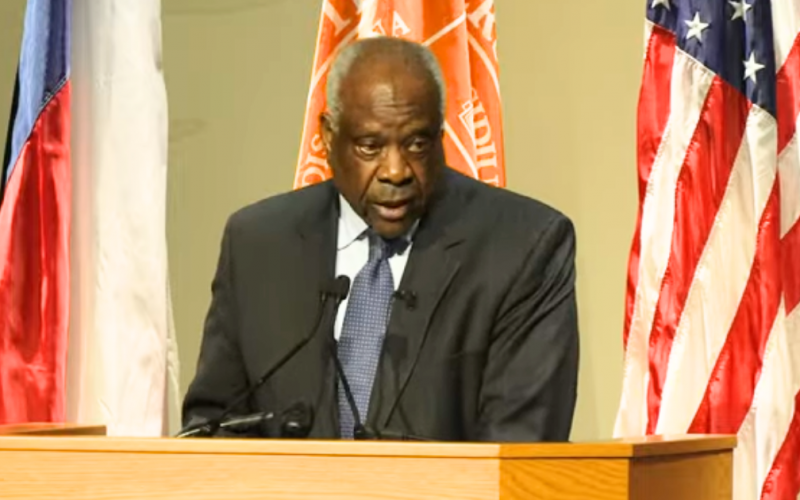
Speaking at the University of Texas at Austin School of Law during an event marking the 250th anniversary of the Declaration of Independence, Thomas framed his remarks around what he described as a long-term struggle over the country’s philosophical direction.
Thomas, appointed to the high court in 1991 by President George H.W. Bush, is the longest-serving current justice.
Addressing law students, he drew on legal and historical themes to describe what he sees as a widening divide between the Founders’ framework of government and later developments in political thought that expanded the role of the state.
During his remarks, Thomas traced changes in American political philosophy over the past century, pointing to the early 1900s as a turning point.
He identified President Woodrow Wilson as a central figure in advancing a governing approach that gained influence in American institutions and public policy.
According to Thomas, this shift reflects a redefinition of liberty itself—moving away from the idea of inherent, pre-political rights and toward a framework in which rights are increasingly treated as contingent on government authority.
He argued that this approach stands in tension with the Declaration of Independence, which grounds rights outside the reach of the state.
“It has coexisted uneasily with the principles of the Declaration because it is opposed to those principles,” Thomas said, according to Breitbart. “It is not possible for the two to coexist forever.”
He added that the competing philosophy envisions rights as originating from government authority rather than existing independently of it.
Thomas also said early advocates of these ideas looked toward governance models that concentrated authority in administrative and bureaucratic systems, rather than dispersed it through limited government structures.
He contrasted this with the American constitutional design, which he maintained was intended to restrain centralized power and preserve individual autonomy, according to RealClearPolitics.
Expanding on the consequences of such systems, Thomas referenced historical examples where concentrated state authority produced destructive outcomes.
He cited regimes led by Joseph Stalin, Adolf Hitler, Benito Mussolini, and Mao Zedong as examples of governments that rejected the concept of inherent rights in favor of state control.
Thomas also connected these broader ideological shifts to landmark Supreme Court decisions, arguing that evolving interpretations of government authority influenced legal outcomes.
He cited Plessy v. Ferguson and Buck v. Bell, pointing to rulings that upheld segregation and sterilization policies as examples of how constitutional rights are interpreted can shift over time.
To reinforce his argument, Thomas quoted President Calvin Coolidge, emphasizing the enduring and fixed nature of the Declaration’s principles.
“If all men are created equal, that is final,” he said. “If they are endowed with unalienable rights, that is final.”
He presented those ideas as foundational truths that should not shift with changing political trends.
As his remarks concluded, Thomas shifted toward civic responsibility, urging individuals to remain engaged in public life and willing to defend foundational principles.
He encouraged students to take part in local governance, speak up in public settings, and stand firm in their convictions even when facing opposition.
“I think if we don’t stand up and take ownership of our country, and take responsibility for it, we are slowly letting others control how we think and what we think,” he said.
Thomas closed by urging Americans to actively uphold the ideals of the Declaration of Independence, stressing that their preservation depends not only on institutions, but on individual participation.
WATCH:
