

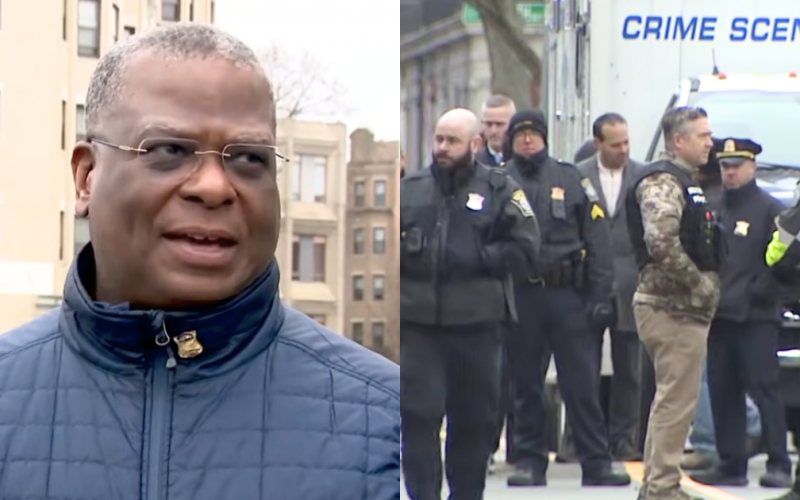
A mental health crisis call in Boston escalated violently Saturday when a man armed with a sword attacked an EMS clinician and a police officer, highlighting growing concerns about unarmed responders facing dangerous situations.
The incident took place steps from the Northeastern University campus.
Boston Police Commissioner Michael Cox explained that officers responded to a 911 call around 10:44 a.m., in which a man reported four armed individuals threatening him.
Officers spoke with the man through a locked door for nearly 45 minutes before he suddenly opened it, striking the EMS clinician and stabbing an officer in the arm.
“One or more officers fired a Taser and their firearm at the individual, bringing the person to a halt,” Cox said.
The attacker was rushed to a hospital and later died.
Several officers and the EMS clinician were hospitalized with non-life-threatening injuries, WCVB reported.
The attack highlights risks inherent in co-responder mental health programs, such as Boston’s BEST initiative, which pairs master’s-level clinicians with officers to de-escalate crisis calls.
Operational since 2011, the program logged 4,230 encounters in 2023 alone, according to Mass Daily.
While programs like BEST are lauded in low-risk scenarios, conservative critics warn that expanding these models into violent situations endangers personnel.
As Mass Daily noted, “CAHOOTS in Oregon has strict limits—they don’t respond to calls involving weapons or violence. The man on Hemenway Street had a sword. Programs built on the activist playbook failed to account for real danger.”
The Boston Police Patrolmen’s Association criticized local leadership.
“The overzealous DA should take a bow now that cops are waiting to get stabbed before taking steps to protect themselves,” the union said, referring to Suffolk County District Attorney Kevin Hayden’s prosecution of an officer in a 2023 self-defense shooting.
That officer, Nicholas O’Malley, faced manslaughter charges after defending himself during an on-duty incident.
Nationally, incidents like Saturday’s reinforce conservative concerns about removing armed law enforcement from dangerous calls.
Similar tragedies have occurred in Seattle, where a housing case manager was fatally stabbed in 2020, and in Melbourne, Florida, where behavioral health worker Travis Knight was killed by a former patient.
Advocates maintain co-responder programs save lives, but opponents caution against expanding them into situations involving weapons.
Boston Mayor Michelle Wu (D), who has supported diverting some 911 calls to behavioral health teams, has not publicly addressed the attack, Mass Live noted.
Northeastern University assured students that the area posed no ongoing threat.
Authorities emphasize the dangers faced by first responders.
“Members of Boston EMS show up to save lives—not to be assaulted,” the department said. “No one should face violence for simply doing their job. Our thoughts are with our injured members, the Boston Police officers, and everyone affected by today’s incident.”
Short-term, the incident raises questions about expanding unarmed mental health interventions into high-risk scenarios.
Long-term, it may influence national debate on crisis response policies, law enforcement authority, and public safety.
Conservatives argue the episode underscores the need for proper risk assessment and the essential role of armed officers in protecting both clinicians and the public.
WATCH:
