

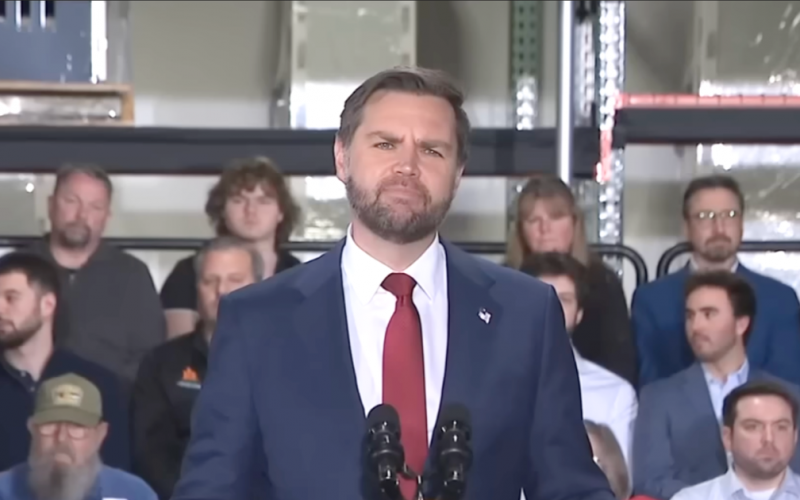
Vice President J.D. Vance’s potential 2028 presidential run is now facing uncertainty as the fallout from the war in Iran continues to grow.
According to sources close to Vance, he has not yet decided whether he will seek the Republican nomination.
One major factor is personal.
Vance and his wife, Usha, are expecting their fourth child this summer, and sources say the growing family is weighing heavily on his decision.
They want to see how another child impacts their lives before committing to a national campaign.
But the political factors may be even more significant.
The ongoing war with Iran is creating new pressure on Vance, whose political identity has long been tied to opposing prolonged foreign conflicts.
As the conflict stretches on, it risks undermining that image.
Sources told The Washington Post that a prolonged war could damage the Republican Party’s next nominee.
That concern has placed Vance in a difficult position.
He has remained noticeably quiet in recent weeks as President Donald Trump continues to push forward with the military campaign.
The silence stands in contrast to his earlier stance against foreign entanglements.
Behind the scenes, tensions appear to be building.
The resignation of former Counterterrorism Director Joe Kent added to the pressure.
Kent, a close ally of Vance, publicly criticized the war and accused the administration of being influenced by outside pressure.
Before Kent’s resignation, Vance reportedly tried to convince him not to turn his departure into a public dispute.
The effort failed, and Kent’s exit exposed divisions within the administration.
At the same time, another figure is gaining ground.
Secretary of State Marco Rubio is increasingly being viewed as a potential successor to Trump, as the Daily Mail reported.
Rubio has taken a more hawkish position on foreign policy and has been closely involved in key military decisions.
He was present during major operations, including strikes tied to both Venezuela and Iran.
Vance, by contrast, was not present at those meetings.
That absence has fueled speculation about his standing within the administration.
President Trump has acknowledged differences between himself and Vance on the Iran conflict.
He said the vice president was “maybe less enthusiastic” and “philosophically a little bit different.”
The political impact is already showing up in early indicators.
Prediction markets suggest Vance’s odds of securing the GOP nomination have declined.
While he once held a clear lead, the gap has narrowed significantly.
Rubio is now nearly tied, signaling a potential shift in the race.
Meanwhile, the broader impact of the war continues to grow.
Gas prices have surged, and global oil markets remain unstable.
The Strait of Hormuz, a critical oil route, remains under threat from Iranian forces.
At least 13 U.S. troops have been killed and more than 200 injured since the conflict began.
All of this adds to the uncertainty surrounding Vance’s political future.
He now faces a complex decision.
Balancing family considerations with rising political pressure, Vance must determine whether a 2028 run is still viable.
As the war in Iran continues, that decision may only become more difficult.
