

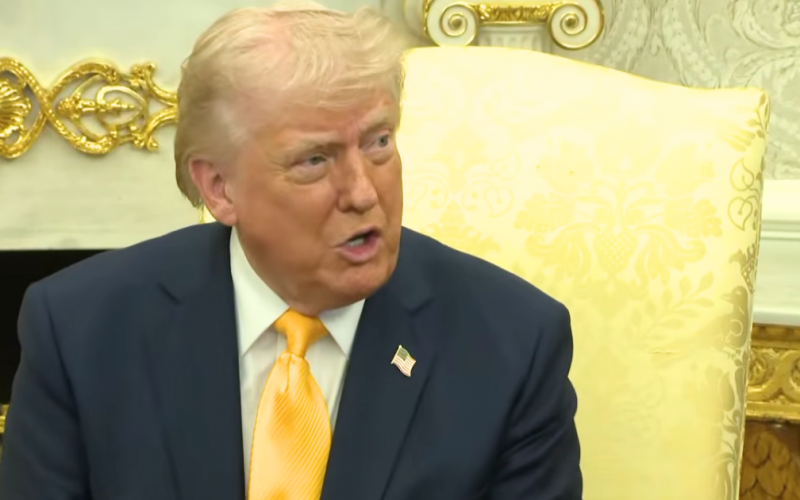
President Donald Trump showcased his decisive leadership and strategic thinking during a joint press conference with Japanese Prime Minister Sanae Takaichi on Thursday.
The discussion turned tense when a Japanese reporter asked why the United States had not informed allies, including Japan, before carrying out military action against Iran.
Trump explained that operational secrecy was essential for mission success.
“You don’t want to signal too much,” he said. “We went in very hard and we didn’t tell anybody about it because we wanted surprise.”
He then added a historical reference, blending bold humor with strategy: “Who knows better about surprise than Japan? Why didn’t you tell me about Pearl Harbor?”
The quip drew laughter in the room while reinforcing his point about the effectiveness of surprise in military operations.
Trump highlighted the immediate impact of U.S. operations, stating that Iranian forces lost approximately 50 percent of their military capabilities within the first two days.
The conversation also addressed securing the Strait of Hormuz, a vital waterway for global oil shipments.
Trump emphasized the need for allied support while acknowledging that domestic and legal constraints restrict some nations’ involvement.
In Japan’s case, the country’s post‑World War II constitution renounces war and has historically limited the scope of military deployments beyond national defense, according to The Guardian.
This framework means Japan’s Self‑Defense Forces can participate in overseas operations only under strict legal and parliamentary approval, often restricting direct involvement in foreign conflicts or coalition missions.
Trump acknowledged Japan’s contributions where feasible, noting that some NATO allies had expressed hesitancy to participate directly in securing safe passage through the Strait of Hormuz.
German Chancellor Friedrich Merz and French President Emmanuel Macron both confirmed that their countries would not engage directly in these operations, according to CNBC.
Their positions reflect broader European caution regarding military involvement in the Middle East, even as the U.S. emphasizes the strategic importance of maintaining open shipping lanes for global trade.
Despite the seriousness of the discussion, Trump used humor to frame the exchange.
His reference to Pearl Harbor highlighted the historical importance of surprise in military operations.
Prime Minister Takaichi responded with composure, outlining Japan’s legal limitations while emphasizing the significance of maritime security.
Trump’s approach reflected a consistent pattern in his leadership: blending direct discussion, historical context, and measured humor when addressing international matters.
His responses emphasized operational considerations and outcomes, highlighting U.S. strategic interests and the importance of effective decision-making on the global stage.
The meeting also highlighted the challenges of coordinating multinational responses to global security threats.
While some allies remain cautious, Trump demonstrated that decisive action paired with strategic communication can achieve measurable results.
By framing the discussion around U.S. operational success and ally limitations, he effectively reinforced a conservative narrative of strong, assertive leadership that prioritizes national interests, Patriot Fetch noted.
Ultimately, the press conference highlighted Trump’s communication style.
By incorporating historical references, humor, and direct discussion, he conveyed information while maintaining diplomatic engagement.
The exchange highlighted U.S. military effectiveness, the role of strategic surprise, and the importance of allied support—core elements of his approach to international security and leadership.
WATCH:
