

The Supreme Court dealt President Donald Trump a major blow Friday, striking down his sweeping tariff policy and putting roughly $175 billion in projected revenue at risk after a 6-3 ruling from the bench.
The decision, written by Chief Justice John Roberts, held that Trump lacked authority under the International Emergency Economic Powers Act of 1977 to impose the tariffs he championed across global trading partners nationwide.
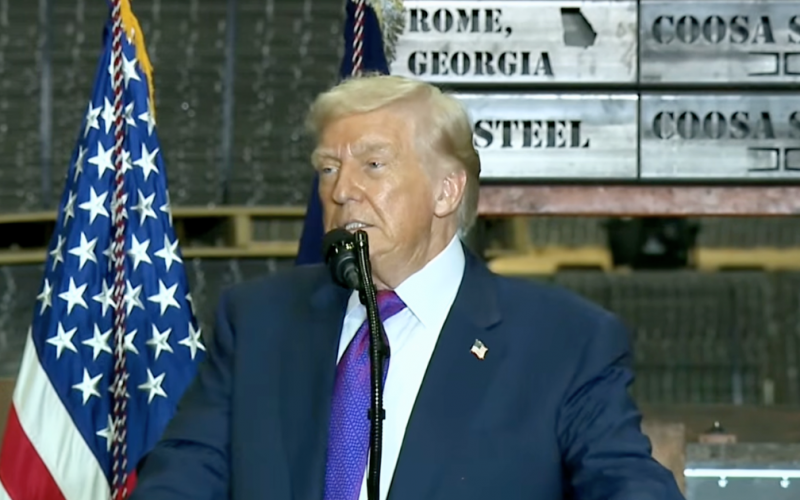
Trump reacted swiftly, calling the ruling a ‘disgrace’ while meeting with the National Governors Association, according to CNN, after reporters had been escorted from the room as news rippled through Washington and Wall Street.
Wall Street traders cheered the outcome, sending stocks higher as investors bet the invalidated tariffs would ease pressure on markets and corporate balance sheets that had braced for prolonged trade uncertainty under Trump’s policy.
At issue was Trump’s reliance on IEEPA, a statute traditionally used for sanctions, which he argued allowed him to declare a national emergency tied to trade deficits and security threats facing the country.
The President had promoted the tariffs as a path to enrichment, celebrating what he dubbed ‘Liberation Day’ on April 2 when he unveiled reciprocal tariffs on countries around the globe, including remote islands.
As he entered office in 2017, Trump imposed tariffs on Mexico, Canada and China over fentanyl flowing into United States, and he threatened a 25 percent levy on Indian imports tied to Russian oil purchases.
Roberts wrote that if Congress intended to grant the distinct and extraordinary power to impose tariffs, it would have done so expressly in statute, as it has in other tariff laws with clarity.
The Chief Justice stressed that the president must point to clear congressional authorization to justify what he called an extraordinary assertion of power, concluding bluntly that Trump could not under the cited law.
For months, Trump had publicly urged the high court to side with him, warning in October that if he did not win the case the nation would be a weakened, troubled financial mess long-term.
He even floated attending oral arguments, saying, ‘I don’t even know if it is survivable,’ before ultimately deciding not to appear amid criticism about separation of powers concerns raised by legal observers nationwide, per the Daily Mail.
Despite a 6-3 conservative majority that includes three of his appointees, Justices Neil Gorsuch and Amy Coney Barrett joined the liberal wing, while Justice Brett Kavanaugh authored the dissent alongside two other conservatives.
Kavanaugh argued that the Court concluded Trump checked the wrong statutory box by relying on IEEPA rather than another available law to impose the tariffs at issue that Congress had already enacted previously.
The ruling noted that Trump could still seek explicit congressional authorization, though doing so would likely require negotiations with Senate Democrats even as Republicans hold majorities in both chambers ahead of midterm elections.
While the justices outlined those possible paths, they did not address how refunds for collected tariffs should be handled, leaving that fight to unfold in lower courts as businesses and consumers await clarity nationwide.
