

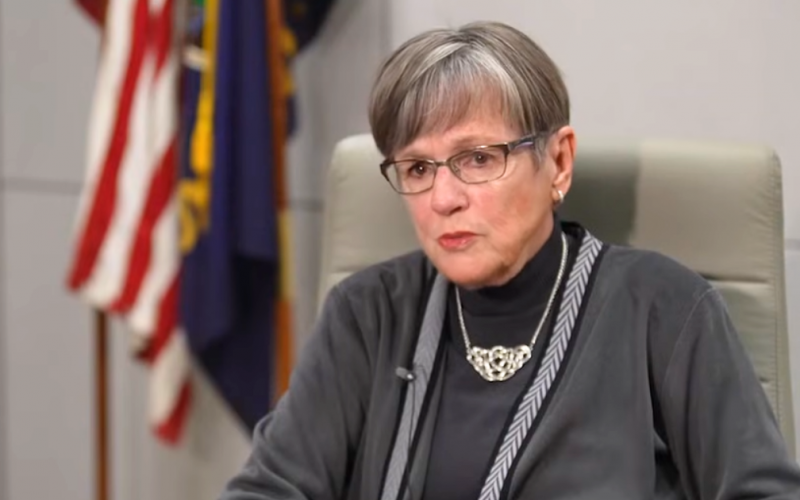
Kansas lawmakers have enacted sweeping restrictions on bathroom access and gender marker changes after overriding Democratic Gov. Laura Kelly’s veto, marking a significant win for Republican leaders who argued the measure protects privacy and safety in government spaces.
Republican supermajorities in both chambers moved swiftly this week to defeat Kelly’s veto of Senate Bill 244.
The Senate voted 31-9 on Tuesday, followed by an 87-37 vote in the House on Wednesday, surpassing the two-thirds threshold required to override.
With the override secured, the measure will take effect upon publication in the Kansas Register, earlier than the standard July 1 implementation date, according to the Topeka Capital Journal.
The new law requires individuals in government buildings, including public schools and universities, to use restrooms, locker rooms, and similar facilities that correspond with their sex assigned at birth.
It also mandates that driver’s licenses and birth certificates reflect biological sex at birth and directs state agencies to invalidate previously issued documents reflecting prior gender marker changes.
Supporters framed the measure as a necessary safeguard for women and children.
“School children, who are they going to encounter in the bathrooms at school?” Republican Sen. Kellie Warren asked during the debate, emphasizing expectations of privacy in spaces where individuals may be in a state of undress.
Kansas House Speaker Dan Hawkins said the legislation provides “clarity, not confusion,” and protects women and girls across the state, KCUR reported.
Senate President Ty Masterson described the override as restoring “sanity” after what he called a “dangerous veto,” arguing the bill prevents biological males from accessing women’s facilities in government buildings.
Supporters rejected claims that the measure was economically motivated, maintaining the focus was on preserving privacy standards in sensitive areas.
Kelly sharply criticized the legislation in her veto message, calling it “poorly drafted” and warning of unintended consequences.
She argued it could create complications in shared hospital rooms, nursing homes, and dormitories and said compliance would cost taxpayers millions of dollars.
“It is nothing short of ridiculous that the Legislature is forcing the entire state… to spend taxpayer money on a manufactured problem,” she said after the override.
Democratic lawmakers condemned both the substance of the bill and the process used to pass it. Debate in the House was cut short when Rep. Barb Wasinger moved to force a vote after limited discussion.
Rep. Abi Boatman, a trans-identifying lawmaker, said the measure “obviously discriminates against transgender people in ways that make our lives exponentially more difficult and dangerous.”
Sen. Cindy Holscher labeled it a “culture war bill” and questioned whether evidence supported claims it would increase safety.
The law includes enforcement mechanisms allowing for civil lawsuits, misdemeanor charges for repeat violations, and financial penalties for government entities that fail to comply.
It outlines limited exceptions, including provisions allowing young children to accompany caregivers into opposite-sex restrooms and permitting coaches to enter opposite-sex locker rooms only if no one is in a “state of undress,” a term the statute does not define.
Advocacy groups, including the ACLU of Kansas and Mainstream Coalition, criticized the measure, arguing it diverts attention from housing, health care, and workforce concerns.
Supporters note that Kansas joins at least 20 other states that have enacted similar restroom restrictions in certain public spaces, reflecting a broader national debate over privacy and biological sex in law.
WATCH:
